Overemployed DevOps Engineer: The Honest Feasibility Guide for 2026
DevOps sits at an unusual intersection of high salary, high demand, and high automation potential. That combination makes it one of the most overemployment-friendly technical careers in the market right now, and the few engineers running two DevOps roles successfully tend to share a small set of habits, tools, and contract terms.
Quick Answer: DevOps engineers are among the most OE-compatible technical roles. Automation-first workflows like Terraform, CI/CD pipelines, and Ansible let a skilled engineer front-load work so both employers benefit without requiring constant presence. The primary obstacle is on-call rotation, which requires deliberate scheduling negotiation with at least one employer before you accept a second offer.
Why DevOps Is Built for Overemployment
The reason DevOps fits the overemployed model so well comes down to one philosophical commitment: the role exists to eliminate manual work. Every hour a DevOps engineer spends configuring a system by hand is, by definition, a failure of the role. Senior practitioners are paid to design systems that run, scale, and recover without human attention. That same automation-first mindset is exactly what lets a DevOps engineer hold two roles concurrently without either employer noticing a productivity gap.
Contrast this with roles built on synchronous coordination. A customer success manager taking 14 hours of calls per week cannot work two roles. A pair-programming-heavy frontend engineer cannot work two roles. A DevOps engineer whose week consists of writing Terraform modules, reviewing pull requests, and watching CI/CD pipelines run can absolutely work two roles, provided they structure their time correctly.
The automation-first mindset
Strong DevOps engineers measure their own performance by what stops needing their attention. The goal is leverage. You write a Helm chart once, and it deploys 40 microservices. You build a self-service Backstage portal once, and 200 developers stop interrupting you for environment provisioning. This is the same leverage that creates space for a second job.
Infrastructure as Code: write once, apply in minutes
Terraform, Pulumi, and CloudFormation reduce hours of manual provisioning to a single `terraform apply`. A change that would take a traditional sysadmin half a day takes a competent DevOps engineer 20 minutes once the module exists. That compression of work-to-output ratio is the foundation of dual-job math.
CI/CD pipelines run without you
GitHub Actions, GitLab CI, Jenkins, CircleCI, and Azure Pipelines all execute without your presence. You write the workflow file, push to main, and the pipeline runs builds, tests, security scans, container image pushes, and deployments without you watching. A well-built pipeline is an async employee that works while you are in a meeting at your other job.
Output is measured in deployments, uptime, and MTTR
Strong engineering organizations measure DevOps work in DORA metrics: deployment frequency, lead time for changes, change failure rate, and mean time to recovery. None of these metrics require continuous seat-time. A DevOps engineer who improves MTTR from 4 hours to 30 minutes and ships infrastructure changes weekly looks like a star regardless of whether they were at their desk every minute of the workday.
Async-first delivery culture
Pull request reviews, IaC planning sessions, architectural decision records (ADRs), runbook maintenance, and Slack-based incident coordination are all async. Compare this with roles that demand real-time pair programming, customer-facing calls, or high synchronous coordination overhead. DevOps lives in the async lane by default. For the broader context on what makes a role OE-compatible, see our best jobs for overemployment breakdown.
DevOps OE Feasibility by Role Type
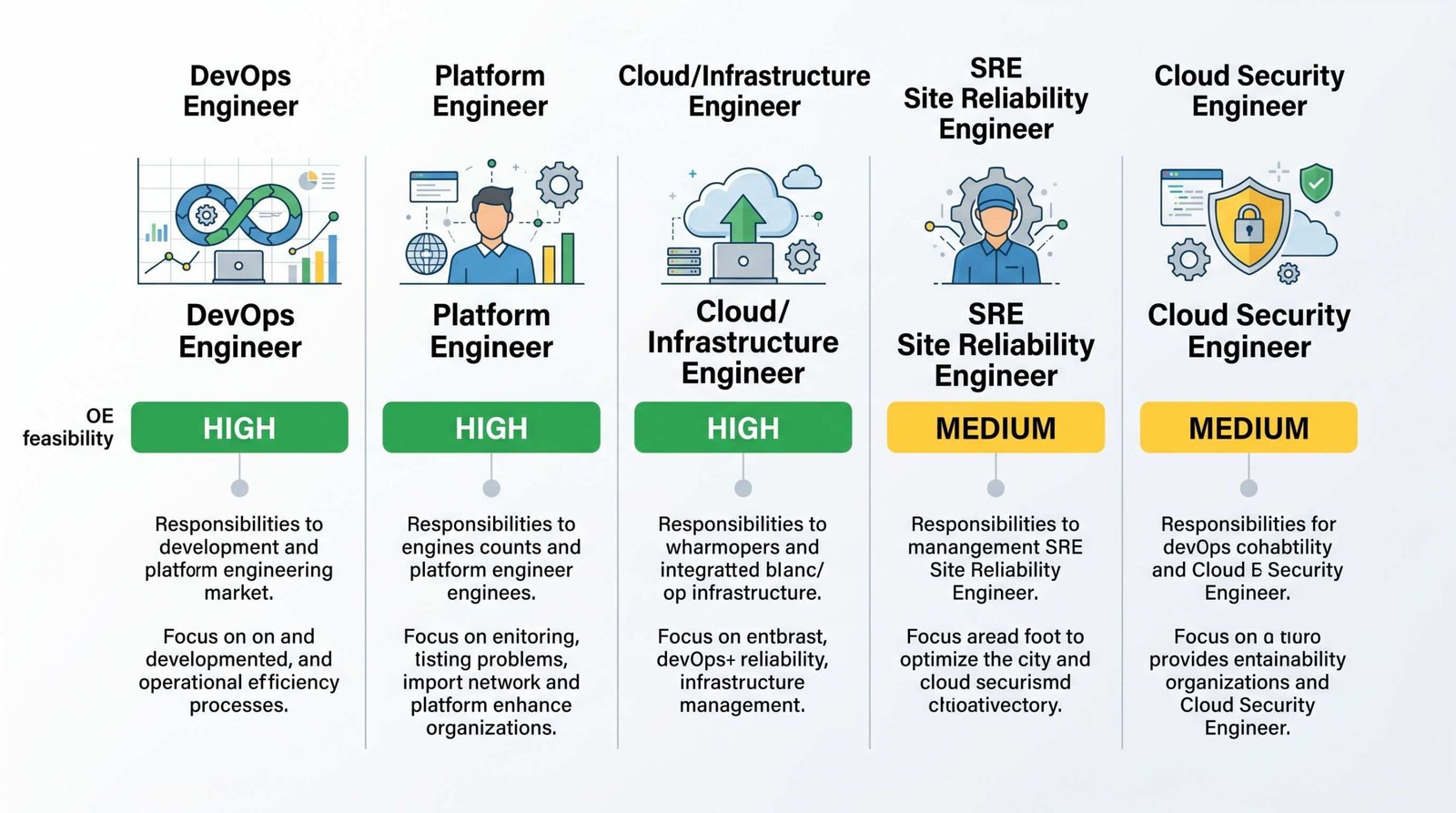
Not every DevOps-adjacent title carries the same OE potential. The difference often comes down to meeting cadence, on-call structure, and the degree of cross-team coordination the role demands. The table below summarizes how five common variants stack up. Salary figures are illustrative based on 2025 to 2026 US market data and will vary by metro, company stage, and seniority.
| Role Type | OE Feasibility | Meeting Cadence | Key Challenge | Median Salary (single J, US) |
|---|---|---|---|---|
| DevOps Engineer (generalist) | HIGH | Low-medium | On-call rotation | $130K to $145K |
| Site Reliability Engineer (SRE) | MEDIUM | Medium | On-call ownership at scale, blameless postmortems | $145K to $165K |
| Cloud / Infrastructure Engineer | HIGH | Low | Account isolation complexity | $125K to $155K |
| Platform Engineer | HIGH | Low | Internal developer platform is async by design | $130K to $160K |
| Cloud Security Engineer | MEDIUM | Medium | Vulnerability response windows, compliance reviews | $135K to $165K |
Generalist DevOps engineers and platform engineers get the green light most often because their work products are well-defined artifacts (modules, pipelines, platforms) rather than constant real-time interventions. SRE roles are workable, but the on-call expectations and incident leadership responsibilities introduce more synchronous demand. Cloud security sits in a similar middle zone because vulnerability response windows can be unpredictable.
The Real Challenges, And How to Handle Them
OE for DevOps engineers is not free of friction. Three problem areas dominate every honest discussion in the community: on-call collisions, cloud credential isolation, and IaC state separation. Below is the field-tested approach to each. The point of this section is not to make OE sound easy. It is to give you the same checklist that experienced OE DevOps engineers run before they accept their second offer.
On-Call Rotation: The Hardest Problem in DevOps OE
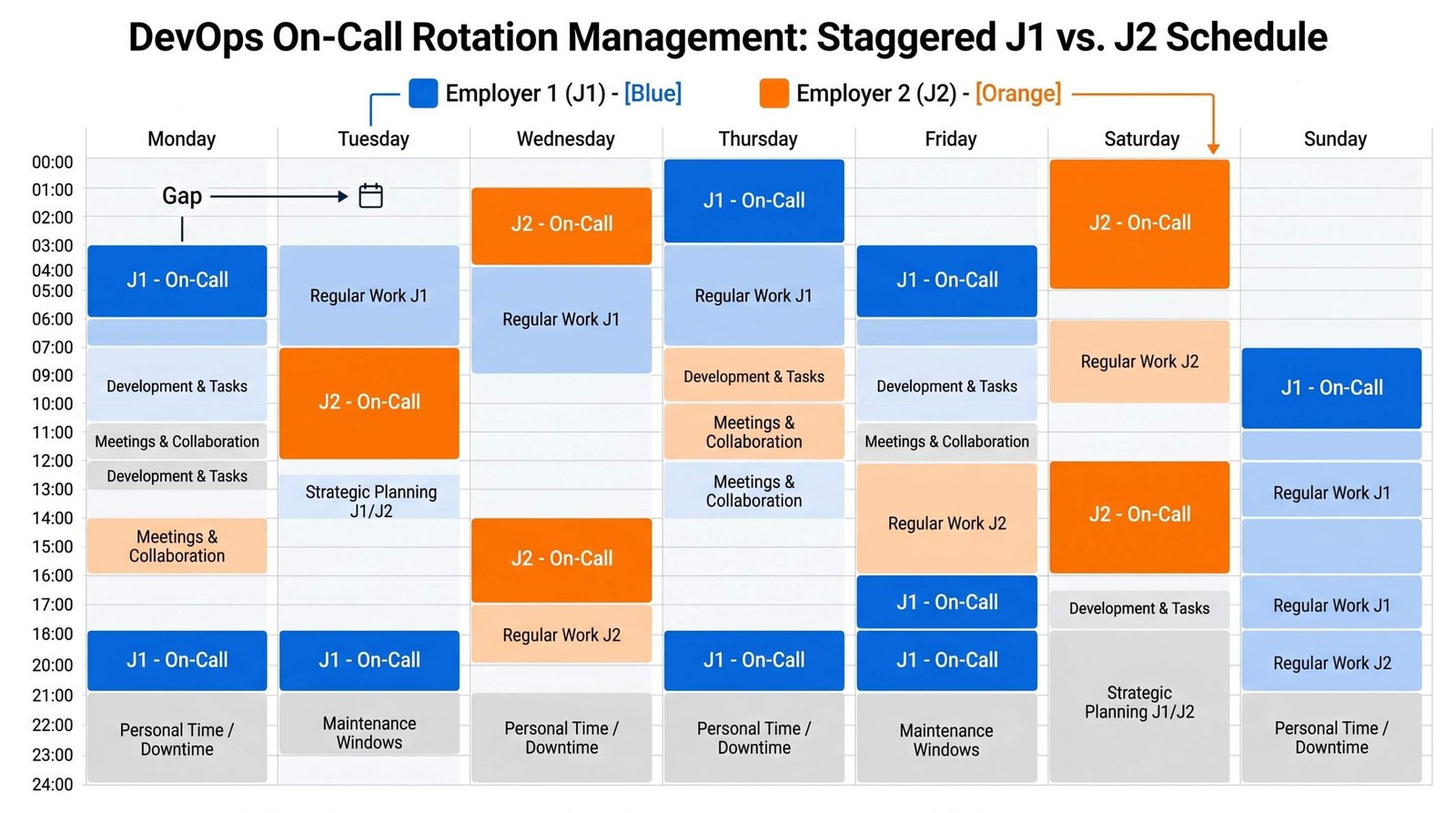
This is the number one risk. Overlapping pages from J1 and J2 during the same week is a critical single point of failure. When a P1 fires at 2 AM on both pagers, you cannot respond to both simultaneously, and either employer noticing slow acknowledgement is a hard signal that something is wrong.
Strategy 1: Calendar negotiation. Trade on-call weeks so J1 and J2 on-call never overlap. This requires knowing both rotation schedules in advance and being willing to swap weeks with teammates. Most rotations are published 4 to 12 weeks ahead. Get those calendars, lay them side by side, and confirm zero overlap before accepting J2.
Strategy 2: Aim for backup at J2. Until you have a clear rotation pattern locked in, target the secondary or backup on-call slot at J2. Backup typically only pages if primary fails to acknowledge within 15 minutes, which is rarer and gives you breathing room.
Strategy 3: PTO during high-risk windows. Take PTO at J2 during J1 on-call weeks that align with major release windows, planned infrastructure changes, or known traffic events (Black Friday, end-of-quarter, large product launches). A handful of strategically placed PTO days each year buys you significant insurance.
Tooling separation. PagerDuty and OpsGenie should be installed on separate phone numbers, or routed through a Twilio number that forwards to distinct apps. Some engineers run J1 PagerDuty on their primary phone and J2 OpsGenie on a cheap secondary device or Google Voice number with custom ringtones. The alerting paths must be distinguishable in milliseconds.
The honest truth. If both J1 and J2 are 24/7 production systems with active on-call rotations, DevOps OE becomes significantly harder. It is achievable but requires explicit scheduling negotiation before accepting J2. Many successful OE DevOps engineers pair a high-intensity J1 with a less on-call-heavy J2 (a platform engineering role at a B2B SaaS company, for example) rather than two equally demanding production roles.
Cloud Account and Credentials Isolation
Cross-pollinating AWS, GCP, or Azure credentials between employers is both a security risk and a detectable footprint. Cloud audit logs are forensic-quality data. If a J1 IAM role ever appears in J2 CloudTrail logs (or vice versa), you have created a paper trail that any security engineer can find.
Use a separate IAM user or service account per employer. Never reuse a J1 profile in a J2 CI/CD pipeline. Generate fresh credentials for each employer and rotate them on the employer’s standard rotation cadence, not your personal preference.
Generate a new ed25519 SSH key per employer. Store each in a distinct keychain entry with a clear name like `j1-company-ssh` and `j2-company-ssh`. Add only one identity at a time to your ssh-agent when switching contexts.
In `~/.aws/credentials`, use named profiles like `j1-company` and `j2-company`. Never use the `default` profile. The default profile is the most common source of accidental cross-employer authentication, because tools like Terraform and the AWS CLI silently fall back to it when no profile is specified. Make the default profile literally empty.
Use separate browser profiles (or separate browsers entirely) for each employer’s cloud console. Chrome profiles are the minimum viable separation. Many OE DevOps engineers go further and run Firefox for J1 and Chrome for J2, eliminating any chance of cookie or session bleed.
Terraform and IaC State Isolation
The most common DevOps credential mistake is sharing a Terraform remote state backend across employers. Do not do this under any circumstances. The state file contains resource ARNs, secret references, and sometimes credentials in plain text. A shared backend is the kind of artifact that ends a career.
Use separate S3 buckets, GCS buckets, or Terraform Cloud workspaces per employer. One backend per employer, full stop. Each backend should live in that employer’s cloud account, not in some shared personal account you manage on the side.
A common misconception worth addressing directly: Terraform workspaces (the feature documented in the official Terraform workspace documentation) are not the right isolation mechanism for multi-employer scenarios. Workspaces within the same backend share state metadata and access patterns. They are designed to separate environments within a single organization (dev, staging, prod), not to separate completely different organizations. Use separate backends per employer, full stop.
Keep employer-specific Terraform modules in separate Git repositories. Never co-mingle. If you build a generic reusable module that is genuinely yours (developed on your own time, on personal hardware, with no employer-owned IP), publish it to your personal GitHub and let both employers depend on it as an external module. But the moment you find yourself copying a module from J1’s repo into J2’s repo, you have created an IP problem.
Git Identity Separation
Set `git config user.email` and `user.name` per-repository, not globally. The default global identity is a frequent source of accidental cross-employer commits, especially when you clone a J2 repo into a default workspace directory and the global config silently applies.
Use `git config –local` for each work repository. Better still, use directory-based conditional includes in `~/.gitconfig` like this pattern:
[includeIf "gitdir:~/j1/"]
  path = ~/.gitconfig-j1
[includeIf "gitdir:~/j2/"]
  path = ~/.gitconfig-j2
Then `~/.gitconfig-j1` sets `user.email = your-j1-email@j1company.com`, and `~/.gitconfig-j2` sets the J2 identity. This makes accidental cross-attribution structurally impossible as long as your repos live in the right directories.
Meeting Footprint Management
DevOps typically has lower meeting density than product manager or business analyst roles, but sprint ceremonies still exist. Standups, sprint planning, retros, and architecture reviews are real time commitments.
The standard OE calendar strategy applies. Put J2 standups in the J1 calendar as generic blocks labeled “focus time” or “deep work.” Schedule J1 meetings around J2 ceremonies, not the other way around (J1 was first, so it stays primary). Terraform apply windows, deployment cutovers, and most production change windows are asynchronous or automated, so they require minimal live presence. For deeper coverage of the dual-calendar approach, see our guide on working two remote jobs.
Automation as Your OE Superpower
If on-call rotation is the hardest problem in DevOps OE, automation is the most powerful counterweight. Every hour you invest in automation early in your tenure compounds into reduced real-time demand later. The OE DevOps engineers who burn out are usually the ones who never automated themselves out of toil.
Front-load infrastructure work. In your first 30 days at a new job, build reusable Terraform modules, write clear self-service runbooks, and create internal tools that remove ad-hoc requests from your plate. The goal is to move from “people Slack me to provision a database” to “people fill out a form and get a database in five minutes.”
CI/CD pipelines as async employees. GitHub Actions, GitLab CI, or Azure Pipelines deploy code, run tests, and alert on failures without your presence. A well-built pipeline is a team member who never sleeps. Invest heavily in pipeline quality during the first month, then reap the benefits for the next 11.
Auto-remediation. CloudWatch Alarms plus Lambda, or PagerDuty Automation Actions, handle common failure modes automatically. If a known-pattern incident happens (disk fills up, a pod restarts repeatedly, a queue grows beyond threshold), the system should fix itself or attempt a fix before paging a human. Every auto-remediation rule you ship is one fewer 3 AM page.
On-call runbooks. Write clear, actionable runbooks so the on-call engineer, whether that is you or a backup, can resolve incidents without needing you live on a call. Good runbooks turn 90 minute incidents into 15 minute incidents. They also turn “I need you on this Zoom” into “I followed the runbook and it is resolved.”
Self-service developer platforms. If you have built the golden path correctly, developers do not need to interrupt you for environment provisioning, database access, or feature flag changes. Internal developer platforms (IDPs) are the highest leverage thing a DevOps engineer can build, and they are exactly what allows the OE math to work.
The Income Math for Dual DevOps
The numbers are why most engineers consider OE in the first place. DevOps salaries are already strong at single-job rates. Dual income compounds the effect, and the geographic flexibility of remote work means many OE DevOps engineers live in low-cost areas while earning two Bay Area or NYC salaries.
| Role Experience | Single-Job Range | Dual-Job Range |
|---|---|---|
| Entry-level (0-2 yrs) | $90K to $110K | $180K to $220K |
| Mid-level (3-5 yrs) | $120K to $150K | $240K to $300K |
| Senior (6+ yrs) | $150K to $200K | $300K to $400K |
| Staff / Principal SRE | $180K to $250K | $360K to $500K |
These are US full-time W2 estimates. C2C contractors typically add 15 to 30 percent on top to offset self-employment tax and the absence of employer benefits. For a mid-level DevOps engineer working two remote W2 jobs at $130K each, dual income lands total compensation in the $260K range before any RSU or bonus stacking. Add a modest 10 to 15 percent bonus from each employer and the figure approaches $300K. Senior engineers with two equity-bearing roles can clear $400K cash plus equity that may double the total package over a four-year vest.
For contractor structure analysis and the tradeoffs between corp-to-corp and W2 employment for OE setups, see our C2C vs W2 structure breakdown. Multiple income streams also create paycheck withholding complexity. The official IRS paycheck withholding guidance for multiple income sources is the right starting point for adjusting your W-4 forms to avoid a surprise tax bill in April.
Staying Legal: What Your Contracts Actually Say
Most employment contracts include an “outside employment” or “conflict of interest” clause. Many of these clauses are overbroad and unenforceable, particularly in states with off-duty conduct protections like California, Colorado, North Dakota, and New York. A blanket ban on any outside work is rarely the legally binding instrument employers think it is, but you need to read your specific contract carefully and ideally have an employment lawyer review it before signing a second offer.
The bigger contractual risk for DevOps engineers is not the moonlighting clause. It is the IP assignment clause. Most employment contracts claim ownership of intellectual property created “during the term of employment,” and some go further to claim anything created “using company resources.” If you write a generic Terraform module on a J1 work laptop during J1 work hours, that module may be claimed by J1 even if you intend to use it at J2. This is the single most important reason to maintain hard separation between employers.
Non-compete agreements are increasingly rare for DevOps roles, especially after recent FTC activity and state-level limitations on enforceability. Still, check your J2 offer letter carefully. A non-compete that specifically names J1 as a competitor is a hard stop. A generic non-compete with no industry overlap is usually low risk.
The National Labor Relations Board has ruled that broad restrictions on outside employment can violate Section 7 rights in certain organizational contexts. The NLRB employee rights page is worth reading once to understand the baseline protections you have as a US worker. For a full legal framework specific to overemployment, our piece on the legal risks of overemployment covers the contractual, tax, and immigration dimensions in depth.
The practical rule is straightforward. Use separate machines. Separate accounts. Separate repos. Separate working hours. Never use J1 resources (cloud credits, paid developer tools, work laptop, work VPN, work GitHub Copilot license) for any J2 work. Treat the two jobs like two completely independent freelance clients, even though they are W2 employers.
How to Find the Right Second DevOps Job
The second job determines everything. A poorly chosen J2 will turn OE into a stress nightmare regardless of how skilled you are. The good news is that DevOps job postings carry strong signals about company culture, and you can filter aggressively without missing many genuine opportunities.
Target async-first employers. Job postings that explicitly say “async-first” or “remote-first” or “globally distributed team” are strong signals. Companies that brag about their async culture in the JD almost always live it. Companies that bury “must be willing to overlap with US East” are flagging synchronous expectations.
Look for absence of excessive ceremony. Scan the job description for meeting load. Postings that list fewer than 3 recurring meetings per week as expected requirements are good candidates. Postings that emphasize “daily standups, planning meetings, retros, and sync reviews” are warning signs.
Infrastructure automation signals. Phrases like “we use Terraform,” “GitOps,” “Kubernetes,” “platform engineering,” and “internal developer platform” all signal an async delivery culture. These shops measure work by what gets shipped, not by who is in the chat. Conversely, postings that emphasize “ticket-driven work” or “white-glove support” lean synchronous.
Interview questions to ask. Two questions surface OE viability fast. First: “What is your typical on-call rotation structure, and how many people are in the rotation?” An eight-person rotation with weekly handoffs is OE-compatible. A three-person rotation with always-on expectations is not. Second: “How does the team coordinate releases? Async via pull requests, or live via deployment meetings?” If the answer is “we have a Friday afternoon deploy meeting where the whole infra team joins a Zoom,” that is a red flag.
What to highlight in interviews. Emphasize automation achievements, self-directed work style, incident reduction track records, and systems you have built that run without manual intervention. DevOps interviewers respond strongly to candidates who talk about leverage and outcomes rather than hours and effort. For the broader job-hunting and interview strategy, see how to become overemployed.
One more consideration: if you are coming from a backend or full-stack background and choosing between continuing as an overemployed software engineer or moving into DevOps, the OE math actually favors DevOps slightly for the reasons covered in this guide. Application engineers tend to live in real-time code review and design discussions. DevOps engineers live in IaC and pipelines. The OE leverage is higher on the infrastructure side. Health coverage and benefit stacking are also worth thinking through if you are running two W2 jobs; our guide on health insurance across two employers covers the tradeoffs. And if you are still in the “is this even possible” phase, our overview on two full-time jobs is a good starting point before you commit.
FAQ
Can a DevOps engineer realistically work two full-time jobs at the same time?
Yes, more realistically than most technical roles. The combination of IaC automation, CI/CD pipelines, and async delivery culture means a skilled DevOps engineer contributes meaningful infrastructure work without continuous presence. The main prerequisite is that on-call rotations at J1 and J2 do not overlap.
What is the single biggest risk of being overemployed as a DevOps engineer?
On-call rotation overlap. If both employers have production on-call responsibilities on the same night or week, you have a critical single point of failure. Cloud account credential cross-contamination is a close second. Never let J1 credentials appear in J2 infrastructure, or vice versa.
How do you manage on-call at two companies as an overemployed DevOps engineer?
The core strategy is schedule negotiation. Before accepting a second offer, establish whether you can trade on-call weeks or take the backup or secondary slot at J2. Use separate PagerDuty or OpsGenie accounts with separate contact numbers. Take strategic PTO at J2 during J1 high-risk on-call windows like major releases or planned maintenance.
Do you need a separate laptop for each DevOps job?
Ideally, yes. Separate physical machines eliminate the risk of accidental cross-employer tool access, cloud credential confusion, and MDM policy conflicts. If that is not practical, use separate VM environments (WSL2 instances on Windows, Parallels VMs on Mac) with distinct browser profiles and shell environments per employer.
Will Terraform credentials get confused across multiple employers?
Only if you allow it. Use named AWS or GCP profiles per employer (never rely on the default profile), separate remote state backends (one S3 bucket per employer), and separate Terraform working directories per employer. Never use Terraform workspaces to separate two employers. Workspaces share a state backend, which is not sufficient isolation.
Is it legal to be overemployed as a DevOps engineer?
Generally yes, assuming your employment contracts do not have an enforceable outside employment restriction. Many moonlighting clauses are unenforceable broad bans. The real legal risk is IP assignment. If you write Terraform modules or CI/CD tooling during J2 work hours using J1 resources like cloud credits or a work laptop, those assets could be claimed by J1. Use separate machines, separate accounts, and separate working hours.