

Best Jobs for Overemployment in 2026 (Ranked by OE Feasibility)
May 13, 2026 | by Ian Adair

Best Jobs for Overemployment in 2026 (Ranked by OE Feasibility)
The best jobs for overemployment in 2026 are software engineering, data science, technical writing, and cybersecurity GRC roles. These positions share three OE-critical traits: async-first communication culture (Slack and email over Zoom), output-based evaluation (judged on deliverables rather than logged hours), and minimal required video presence. Avoid roles with on-call rotations, daily standups, or camera-on meeting policies.

Most “best remote jobs” lists rank positions by salary and availability. That framework is useless if you’re running two full-time jobs simultaneously. A $200K role with three hours of daily meetings and a rotating on-call schedule will torch your second income within weeks. A $130K role at an async-first SaaS company can run quietly in the background for years.
What follows is a different evaluation framework, built specifically for people working two or more remote jobs. Each job category is rated 1-5 on OE Feasibility, with concrete signals to look for in job descriptions and watch-outs that disqualify otherwise promising roles. We’ve also included the jobs that look OE-friendly on paper but aren’t, because that distinction matters more than another ranked list of remote titles.
What Makes a Job Overemployment-Feasible?
Job feasibility for overemployment has almost nothing to do with seniority, salary, or even technical complexity. A senior staff engineer at an async-first company has a structurally easier OE setup than a mid-level project coordinator at a meeting-heavy startup. The four criteria below determine whether a role can survive a second job running alongside it.
The 4 Criteria That Actually Matter
1. Async-first communication culture. The single biggest predictor of OE feasibility is how a team communicates. Slack, GitHub comments, Notion docs, and email are async tools: you respond when it’s your turn at the keyboard, which can be 20 minutes or 3 hours later. Video calls and impromptu Zoom huddles are synchronous: they consume a specific block of your time, and that block is double-booked if you have another employer. Companies that default to written communication are structurally easier to overemploy at, regardless of what the job title is.
2. Output-based evaluation. Some companies measure performance by shipped deliverables. Others measure by activity: hours logged, Slack response time, calendar utilization, and time-tracking software. Output-based evaluation is the foundation of OE viability because nobody is watching the clock as long as the work ships. Activity-based evaluation creates constant background pressure that’s incompatible with running a second job in parallel. Watch for language like “results-oriented” or “ownership-driven” versus “high-energy” or “fast-paced.”
3. Predictable meeting schedule. A job with six hours of scheduled meetings per week is workable. A job with two hours per week of meetings plus seven hours of unpredictable real-time pings is much harder. OE works because you can block-plan your week across two jobs, but only if meetings are predictable. Roles where calendar invites land with 30 minutes of notice for “quick syncs” destroy block planning. Predictability matters more than total meeting volume.
4. Low team interdependency. If you’re the critical path for 12 other people, your absence for two hours blocks 12 people from doing their jobs. That’s untenable. Solo contributor work, where you own a discrete area and other people can route around you for a few hours without dependency hits, is the structural pattern that makes OE work. This is why specialist IC roles work better than coordinator roles, even when the coordinator role pays more.
Jobs That Look OE-Friendly But Aren’t
Three job categories deserve specific warnings because they regularly trap new OE practitioners:
Project Manager / Program Manager. Technically remote, often well-paid, and frequently advertised as flexible. In practice, PMs are the critical path for entire teams. The job is structurally synchronous: you facilitate standups, run sprint planning, unblock cross-functional dependencies, and handle escalations in real time. Zoom calendar density is usually 4-6 hours per day. Avoid.
Customer Success Manager. Sounds async because it’s “relationship management,” but the daily reality is back-to-back live client calls, quarterly business reviews, and renewal conversations. Customer-facing roles that involve external stakeholders almost always require camera-on availability during specific hours, often across multiple time zones. Even “low-touch” CSM roles have unpredictable urgency when accounts churn.
Agile Team Lead / Scrum Master / Engineering Manager. The job title says “lead,” but the day-to-day is meetings: standups, 1:1s, sprint planning, retrospectives, cross-team syncs, leadership reviews. Even at async-first companies, manager roles have meeting loads that double-book impossibly across two jobs. If you’re managing the path to OE, IC roles are the destination, not the launching pad.
The Best Jobs for Overemployment
Each job category below includes an OE Feasibility Rating from 1 (avoid) to 5 (ideal), specific signals to look for in job descriptions, and the watch-outs that downgrade an otherwise promising role.
Software Engineer / Developer (OE Feasibility: 5/5)
Software engineering is the prototypical OE role for structural reasons, not just compensation. The work is largely solo between code review cycles, output is judged by commits and PRs rather than screen time, and most tech companies default to async communication through GitHub, Slack, and written design docs. IDEs don’t require meetings. A senior backend engineer at a healthy company can complete two days of work in one focused half-day, leaving the rest of the calendar for a second job.
Signals to look for: “async-first” or “remote-first” in the job description, no on-call rotation explicitly mentioned, “results-oriented” or “ownership” language, IC role (not tech lead), backend or platform work over frontend customer-facing features. Documentation-heavy companies (Stripe, GitLab, HashiCorp-style) tend to be excellent.
Watch-outs: Gaming companies, fintech with live trading systems, ad tech, and any role with real-time production support requirements. SRE roles look like engineering but include on-call rotations that are incompatible with OE. Startup-stage companies under 50 people often have meeting density that contradicts the industry norm.
Data Scientist / ML Engineer (OE Feasibility: 5/5)
Data science work is structurally deep-work: extended analysis, model training, and report writing that doesn’t tolerate interruption well. Companies know this, so the meeting load tends to be light. Output is models, dashboards, and written analyses, none of which require synchronous presence. The work pattern of “long quiet stretches with periodic stakeholder reviews” maps cleanly to a second job’s calendar.
Signals to look for: “Individual contributor” framing, no mention of rotating on-call, embedded in research or analytics teams rather than product squads, deliverables described as “studies” or “models” rather than “features.” Mid-to-large companies with established data platforms tend to have lower meeting loads than early-stage companies still building their data stack.
Watch-outs: Data engineering roles at companies with complex real-time pipelines can have unexpected on-call burdens when ETL jobs break overnight. ML platform roles serving internal customers often blur into infrastructure work with associated incident loads. Avoid roles where the job description mentions “real-time inference” or “production ML systems availability.”
Technical Writer (OE Feasibility: 5/5)
Technical writing is the most underrated OE role in the industry. The work is entirely output-based: pages of documentation, API references, tutorials, and release notes. Meeting load is minimal because writers consume information rather than coordinate it. The work rhythm is low-urgency, which means async by default. Many senior technical writers at SaaS companies earn $130-180K with meeting calendars that fit in five hours per week.
Signals to look for: Contractor-style documentation projects, IC documentation roles at established SaaS companies (Stripe, Twilio, MongoDB, Datadog all have strong technical writing cultures), “documentation as a product” framing, separate documentation team rather than embedded writers. The phrase “we treat docs as code” is a strong positive signal.
Watch-outs: Companies that embed technical writers in agile squads with daily standups. Documentation roles that include video tutorial production or webinar hosting. Any writing role at a content marketing-heavy company where you’ll be pulled into campaign planning.
Cybersecurity Analyst (OE Feasibility: 4/5)
Security is a wide category with very different OE profiles by sub-role. GRC (governance, risk, compliance) work is almost entirely documentation and assessment: writing policies, conducting risk assessments, managing audit evidence, and reviewing vendor security questionnaires. It’s heavily async, heavily output-based, and pays well. Security architecture and security engineering roles can also work, with similar structural properties to software engineering.
Signals to look for: “GRC analyst,” “security documentation,” “compliance engineer,” “security architect” in job titles. No 24/7 SOC rotation mentioned. Industries that need compliance work but aren’t security-first (most non-tech companies) tend to have predictable security roles.
Watch-outs: SOC Tier 1 and Tier 2 analyst roles are incident-driven and shift-based, completely incompatible with OE. Detection engineering can be on-call heavy. Avoid any security role at fintech, healthcare, or government contractors where breach response is genuinely 24/7. The phrase “incident response on-call” disqualifies a role immediately.
Digital Marketing / SEO Specialist (OE Feasibility: 4/5)
Marketing splits sharply by sub-discipline. SEO and content strategy are highly async because the work is research, writing, and analysis with weekly or monthly reporting cycles. Campaigns have predictable launch dates, and execution is mostly independent. Agency-side marketers are particularly OE-ready because the work pattern of juggling multiple clients translates directly to juggling multiple employers.
Signals to look for: “Independent contributor,” “content strategy,” “SEO specialist,” “growth marketing” with a focus on owned channels. Agency roles with multiple client portfolios. In-house roles at companies with established marketing functions (not first marketing hires at startups).
Watch-outs: Paid media managers with active campaign budgets need to monitor performance in something close to real-time, especially during launches. Social media management has urgency cycles when content goes viral or PR issues hit. Brand marketing roles at consumer companies often have heavy creative review meeting loads. Bureau of Labor Statistics data shows digital marketing growing 6% annually through 2032, which means supply of these roles is steady.
DevOps / Cloud Engineer (OE Feasibility: 4/5)
Infrastructure work is largely project-driven with clear deliverables: Terraform modules, CI/CD pipelines, Kubernetes configurations, cloud migrations. The work is highly async because infrastructure code reviews itself. Platform engineering teams that build internal tooling for other engineers tend to have the best OE profile because their “customers” are other developers who communicate via tickets.
Signals to look for: “Infrastructure as code,” “platform engineering,” “developer experience,” “internal tooling.” Job descriptions that focus on building rather than operating. Roles at companies large enough to have separate platform and SRE teams.
Watch-outs: The dealbreaker is on-call rotation. Always ask directly in interviews: “Is there an on-call rotation for this role, and what’s the cadence?” If the answer is anything other than “no” or “very rare, only for specific incidents,” the role isn’t OE-compatible. SRE titles almost universally include on-call. The phrase “production reliability” usually signals on-call obligations.
UX Designer / Product Designer (OE Feasibility: 3/5)
Design work is naturally async at the craft level: wireframes, prototypes, design systems, and visual exploration all happen in Figma or similar tools without anyone watching. The challenge is feedback cycles. Good design requires more synchronous review than engineering because stakeholders need to see and react to visual work. Designers also tend to get pulled into customer research, which is video-heavy.
Signals to look for: “IC designer,” design roles on teams with established design systems (less ongoing systems work), companies with strong design ops functions that handle research logistics. B2B SaaS tends to have lighter design meeting loads than consumer products.
Watch-outs: Companies that expect designers in all product meetings, on customer research calls, or in regular design critique sessions with cameras on. Early-stage product design roles where you’re embedded in fast-moving product squads. Avoid design lead or design manager titles entirely.
Content Creator / Copywriter (OE Feasibility: 3/5)
Pure writing work is among the most async work that exists: it’s just you and a document. The issue with full-time W2 copywriting roles is that revision cycles require synchronous input that’s hard to predict. Stakeholders want to “jam on the headline” or “do a quick review session.” Pure copywriting often works better as contract or freelance work where scope is defined upfront and revision cycles are structured into the contract.
Signals to look for: Clear deliverable scope (X pieces per week), no mention of “collaborative real-time editing,” no “ideation sessions” in the description, contract or 1099 roles over W2 where possible. SEO content writing is particularly clean because briefs are well-defined and revision cycles are limited.
Watch-outs: Any copywriting role at an advertising agency. Brand copywriting positions that involve creative review meetings. Content roles that include video scripting or podcast production. Long-form journalism positions with editor-driven revision cycles.
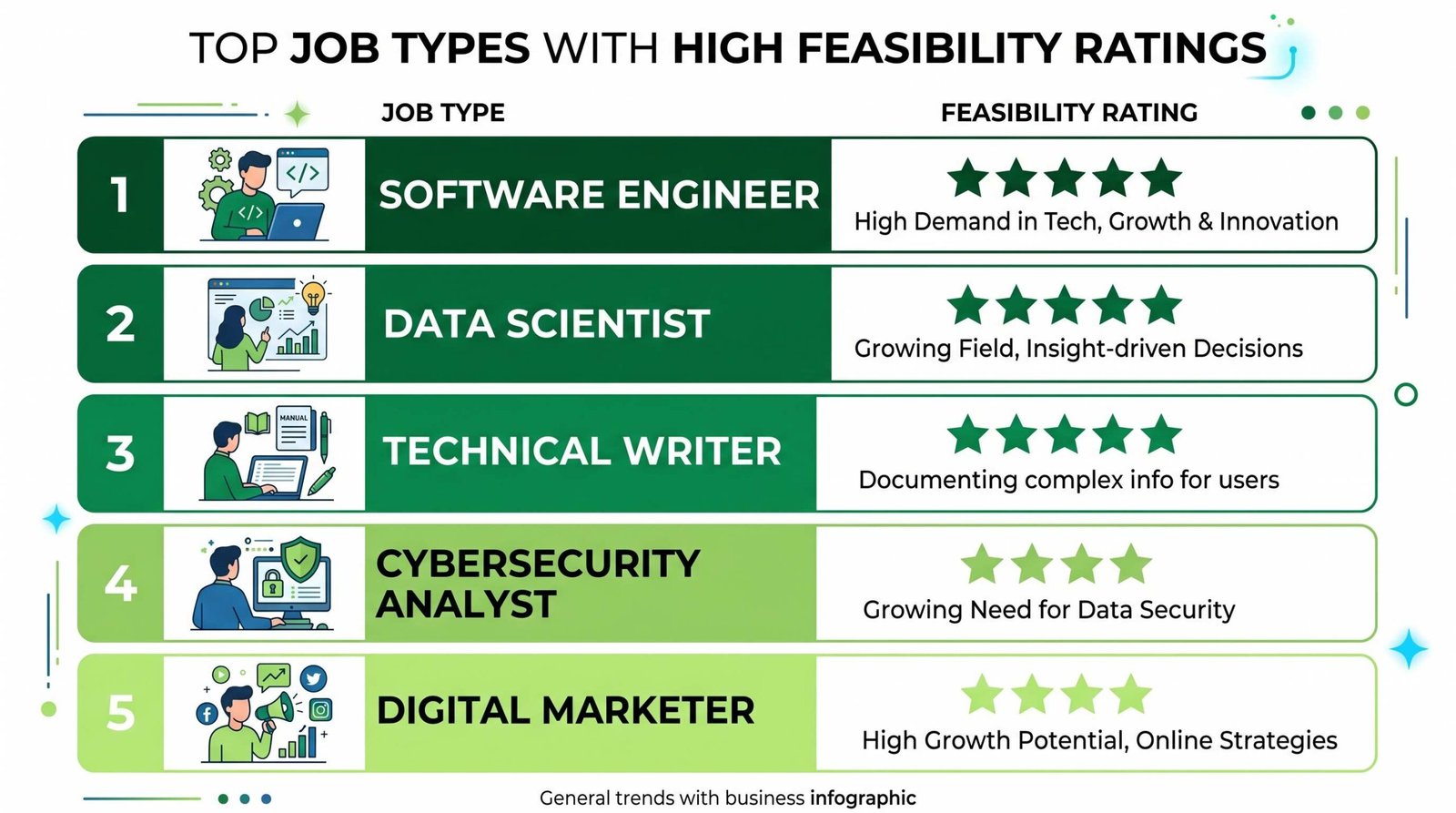
OE Job Feasibility Comparison Table
| Job Type | OE Feasibility | Primary Risk Factor | Best Company Type | Avoid These Roles |
|---|---|---|---|---|
| Software Engineer | 5/5 | On-call rotation creep | Documentation-heavy SaaS (Stripe, GitLab style) | SRE, gaming, real-time fintech |
| Data Scientist / ML Engineer | 5/5 | Real-time pipeline incidents | Mid-to-large companies with established data platforms | Real-time ML inference, data engineering on small teams |
| Technical Writer | 5/5 | Embedded squad assignments | SaaS companies with dedicated docs teams | Video tutorial producers, marketing-aligned writers |
| Cybersecurity Analyst | 4/5 | Incident response on-call | Non-tech companies needing compliance | SOC Tier 1/2, incident response, detection engineering |
| Digital Marketing / SEO | 4/5 | Campaign-driven urgency spikes | Agencies, in-house at established companies | Paid media with live budgets, social media management |
| DevOps / Cloud Engineer | 4/5 | On-call rotation | Platform engineering teams at large companies | SRE, production reliability roles |
| UX / Product Designer | 3/5 | Synchronous feedback cycles | B2B SaaS with established design systems | Design leads, early-stage product squads |
| Content Creator / Copywriter | 3/5 | Unpredictable revision cycles | SEO content shops, contract arrangements | Ad agencies, brand creative teams |
How to Evaluate a Job Offer for OE Potential
The interview process is your only chance to assess OE feasibility before signing. The good news is that every question worth asking has a legitimate non-OE rationale. You’re not revealing anything by asking about meeting culture, evaluation philosophy, or on-call expectations. Senior candidates ask these questions routinely.
Questions to Ask in Interviews (Without Revealing Your Intent)
“How does the team typically communicate day-to-day?” The answer reveals async versus sync culture immediately. “We’re heavy on Slack and async docs, with focused meeting blocks twice a week” is a green light. “We’re a high-energy team that’s always jumping on quick calls” is the opposite. Listen for whether they describe written communication as the default.
“What does a typical week look like in terms of scheduled meetings?” You’re asking about meeting density without sounding meeting-averse. Good answers describe specific recurring meetings with bounded durations. Bad answers are vague or describe a culture of impromptu calls. Anything above 12 hours of weekly recurring meetings is structurally hard to OE.
“How is performance evaluated? Are you more focused on output or process?” This is the most direct evaluation question you can ask. Companies with strong output-based cultures answer with specific deliverables and outcomes. Companies with activity-based cultures answer with metaphors about teamwork, energy, and collaboration.
“Is there an on-call rotation for this role?” Direct, expected, and non-revealing. Every senior candidate asks about on-call. Listen for the specific cadence, escalation policy, and frequency of actual pages. “We have a once-a-quarter on-call week” is workable if the page rate is genuinely low. “We have a 24/7 rotation across six engineers” is not.
“What collaboration tools does the team use?” Slack-heavy teams tend to be more async than Zoom-heavy teams. Linear, Notion, and GitHub usage are positive signals. If the answer leans toward “we live in Zoom” or “we have a lot of Google Meet rooms running,” that’s a red flag for meeting density.
Job Description Green and Red Flags
Green flags in job descriptions: “async-first,” “remote-first” (different from just “remote”), “results-oriented,” “high autonomy,” “individual contributor,” “flexible schedule,” “no on-call required,” “documentation culture,” “ownership-driven,” “deep work valued.” Companies that publish detailed remote work handbooks (GitLab, Doist, Automattic) tend to translate the language into actual culture.
Red flags in job descriptions: “fast-paced collaborative environment,” “daily standups,” “real-time collaboration,” “on-call rotation,” “high-visibility customer-facing role,” “always-on team,” “energetic,” “hustle,” any mention of “camera on” policy, any reference to time tracking or activity monitoring. The phrase “we work like a small team even at scale” usually means meeting-heavy. According to Stanford’s WFH Research, roughly 25% of full work days in the United States are now performed from home, which means the pool of OE-friendly roles continues to expand.
Managing Risk When Working Two Remote Jobs
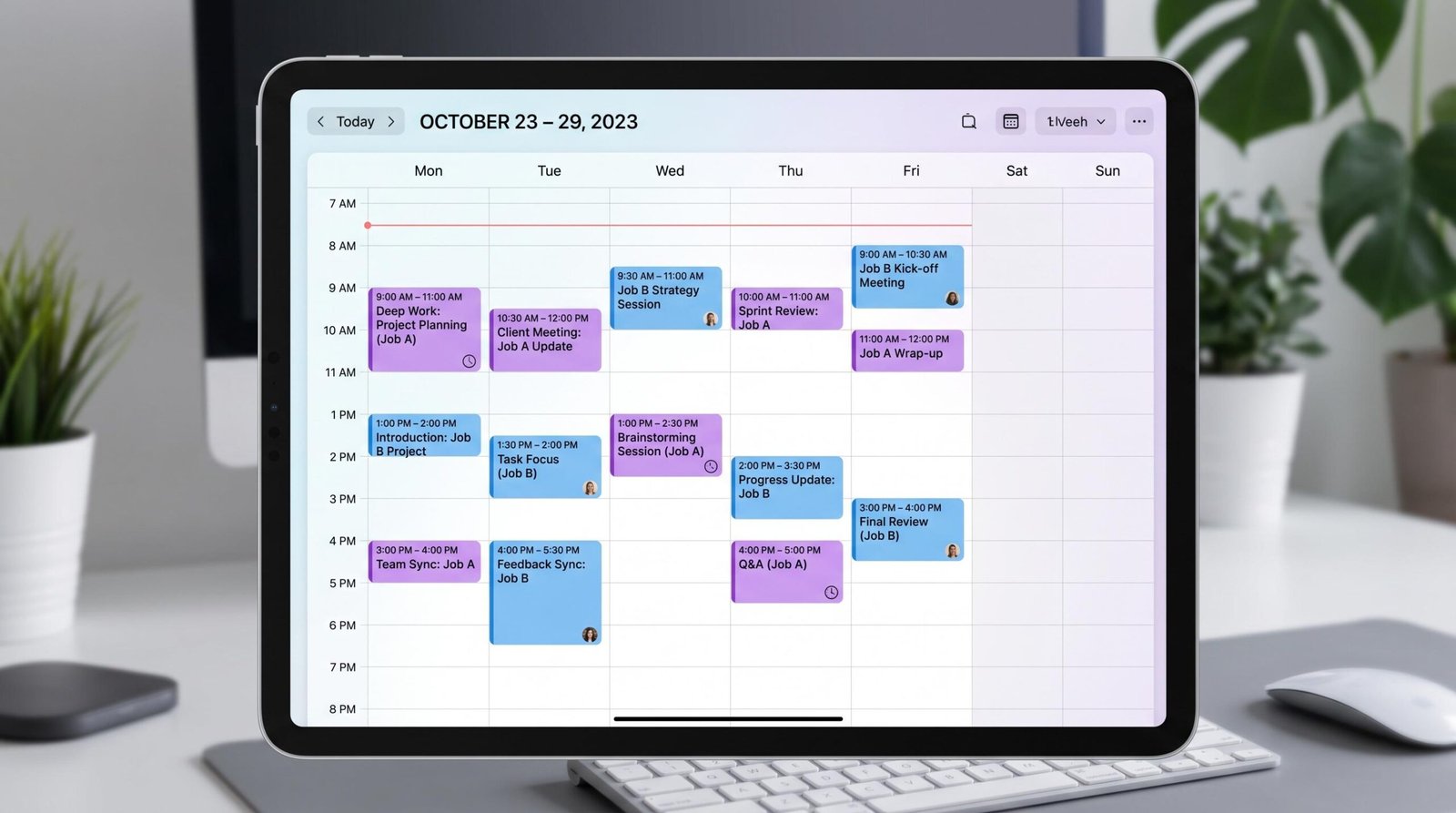
Once you’ve landed an OE-feasible role, the operational mechanics matter as much as job selection. Calendar blocking is non-negotiable: every meeting on J1 should have a “focus block” placeholder on J2’s calendar, and vice versa. Never let two critical meetings overlap, because the cost of dropping one is exponentially worse than the cost of missing a low-priority sync.
Notification management is the second discipline. Configure each laptop with notifications that are unmistakably distinct: different Slack notification sounds, different desktop wallpapers, separate browser profiles. The friction of accidentally responding to J1 from J2’s account is the most common operational mistake new OE practitioners make.
Activity monitoring software is increasingly common at risk-conscious employers, particularly in financial services and healthcare. We’ve covered the practical countermeasures in our guide to managing activity monitoring tools, which walks through the hardware and software options. The broader principle is to assume your activity may be visible and structure your work patterns accordingly: consistent presence during working hours, predictable response times, and outputs that match the visible activity.
Finally, build a clear escalation protocol for moments that genuinely require undivided attention: production outages on J1, executive escalations on J2, customer crises that need same-day resolution. Pre-decide which job gets priority in which scenarios so you’re not making the call under pressure. For more operational guidance, see the resources at Overemployed Toolkit.
Frequently Asked Questions About Jobs for Overemployment
Is overemployment legal?
In most United States jurisdictions, working multiple jobs is legal at the federal level. The relevant constraints come from employment contracts, particularly non-compete clauses, exclusivity provisions, and conflict-of-interest policies. Many employment agreements include a clause requiring disclosure of outside work. Whether overemployment violates a specific contract depends on the contract’s terms and the nature of both jobs. Government contractor positions and roles with security clearances have stricter rules. We suggest reviewing your employment agreement carefully before pursuing overemployment, and avoiding direct competitors as your second employer.
What percentage of remote workers are overemployed?
Reliable hard data is limited because overemployment is rarely self-reported. Estimates from remote work surveys suggest that 5-10% of fully remote knowledge workers hold a second full-time job at any given time, with the rate being higher in software engineering, data, and writing roles. The number has grown alongside the broader shift to remote work since 2020, particularly as companies move toward output-based evaluation.
Can you get fired for overemployment?
Yes, if discovered, most employers will terminate for cause based on contract violations, conflict of interest, or breach of duty of loyalty. The financial impact is typically loss of the job rather than legal liability, though specific contracts may include clawback provisions for compensation paid during the overlap. Termination usually does not result in legal action beyond contract enforcement. The practical risk is being detected: most discoveries come through LinkedIn updates, mutual connections, tax records visible to specific employers, or background check vendors reporting concurrent employment to current employers.
What’s the highest-paying job for overemployment?
Senior staff and principal software engineering roles at large tech companies pay $300-500K per position, making the combined OE income $600K-1M+. Data science and ML engineering at the same seniority level are comparable. Specialized cloud architecture and security architecture roles also reach this range. The highest absolute earners in OE communities tend to be senior engineers at companies with strong total compensation packages including equity.
Do you need to disclose overemployment to your employer?
Most standard United States employment agreements include some form of outside-work disclosure clause, though the specific obligations vary. Some require disclosure of any concurrent employment, others only require disclosure of competitive employment or activities that create conflicts of interest. People practicing OE typically operate without disclosure, accepting the contractual risk. Whether disclosure is legally required versus contractually required is a meaningful distinction worth understanding for your specific situation.
What productivity tools help manage overemployment?
The core toolkit includes calendar management (Google Calendar with multiple accounts, Reclaim.ai for automatic time blocking), notification management (separate browser profiles, distinct notification sounds per device), activity management tools where applicable, and task management with clear separation between J1 and J2 work streams. Two separate physical laptops are standard. Some practitioners use a KVM switch or dual-monitor setup to manage both machines from one workstation. Documentation discipline matters as well: keep separate notebooks or Notion workspaces per job so context-switching is fast and clean.
RELATED POSTS
View all


C2C vs 1099: Which Contractor Structure Actually Pays More? (2026)
December 22, 2023 | by overemployedtoolkit.com

Moonlighting Policy: What Your Employer Can (and Can’t) Restrict in 2026
May 23, 2026 | by Ian Adair

Overemployed Health Insurance: Dual Coverage Guide 2026
December 22, 2023 | by overemployedtoolkit.com