

Overemployed Business Analyst: The Honest Feasibility Guide for 2026
December 22, 2023 | by overemployedtoolkit.com
Overemployed Business Analyst: The Honest Feasibility Guide for 2026
Yes, a business analyst can absolutely be overemployed. BA work is predominantly asynchronous, document-driven, and outcome-based, which makes it one of the more practical knowledge-work roles for running two full-time W-2 jobs simultaneously. The real constraint is not weekly hours but managing unpredictable discovery sessions and stakeholder interviews across both employers without scheduling collisions.
If you found your way here, you already know what OE means. You have probably lurked on r/overemployed, read the testimonials about engineers doubling their income, and wondered whether the BA seat you occupy from nine to five is actually compatible with the playbook. The short version: it is, and in some ways business analysts have structural advantages that engineers do not. The longer version is what this guide is for.
This is not a romance piece. Running two BA jobs is doable for thousands of people right now, and it is also a discipline. You need to think about your tooling, your calendar hygiene, your document fingerprints, and the way your two employers might bump into each other in the wild. We will walk through all of it, including the income math, the risks specific to the BA role family, and how to land that second seat without raising flags.
Why Business Analysts Are Built for OE
The OE community has long focused on engineering roles because the early adopters were software engineers riding the post-2020 remote wave. What got missed in that focus is that business analyst work has even better structural fit for running two jobs concurrently. Engineers commit code with timestamps, attend daily standups, and participate in pair programming sessions that are inherently synchronous. Business analysts produce documents, conduct interviews on their own calendar, and operate in a rhythm that is fundamentally async-friendly.
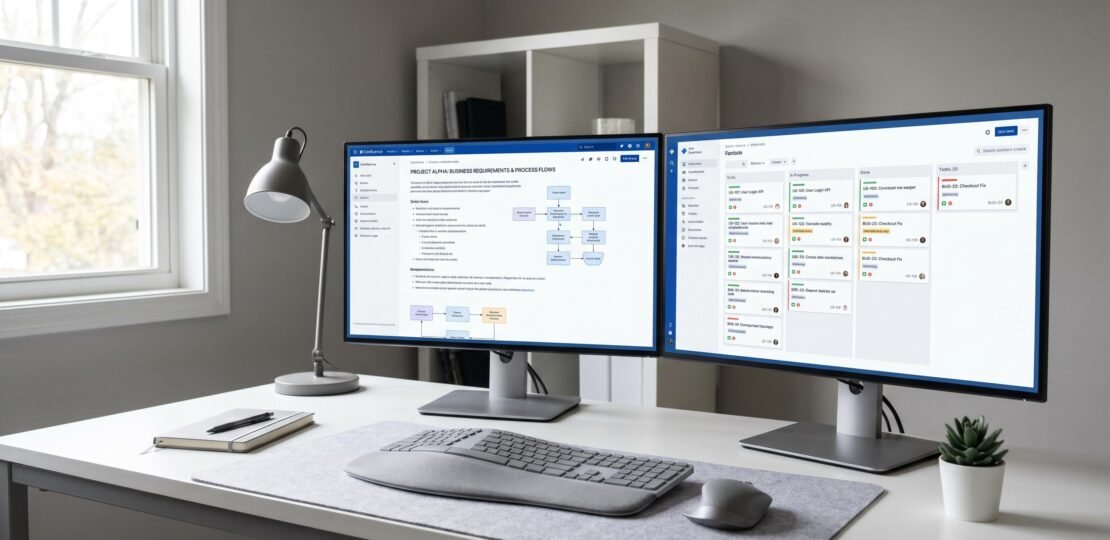
The output of a business analyst is artifacts. Requirements documents, process maps, user stories, gap analyses, BRDs, FRDs, and the endless lineage of Confluence pages that grow as projects mature. These artifacts are typically reviewed asynchronously, edited collaboratively over days or weeks, and judged on quality and completeness rather than the wall-clock time spent producing them. A senior BA who delivers a clean requirements document on Friday afternoon is not being evaluated on whether they spent 40 hours or 12 hours producing it. They are being evaluated on whether stakeholders agree the requirements are correct and whether engineering can build from the spec.
Requirements documentation lives in Confluence, Notion, SharePoint, or Jira. These tools were built for async collaboration. A BA can write a draft at 11pm, share it for review, and let stakeholders comment over the next two business days. The tool itself does not care when you wrote the content. This is materially different from engineering work where Git commit timestamps create a visible activity log, or from customer success roles where you are expected to respond to customer Slack messages within minutes during business hours.
Stakeholder interviews and discovery sessions, which constitute the synchronous portion of BA work, are scheduled in advance. You control when they happen on your calendar. If you need an hour with the head of operations to clarify a process, you book the hour. You do not get pulled into ad-hoc emergencies the way support engineers or DevOps people do. The synchronous load is predictable because you do the scheduling.
Many BA roles are explicitly outcome-based. Companies hire business analysts to deliver specific projects, not to staff a phone line. The bonus structure, the performance review criteria, and the day-to-day expectations all orbit around project completion. As long as your deliverables land on time and at the expected quality bar, your manager is not counting hours.
Remote BA roles are common and have been since 2020. This matters because the management infrastructure at companies hiring remote BAs has matured. Remote-first BA teams have async standups, written status updates, and documented decision logs because they have to. Those same structures make OE practical. If you want a sense of how BA work compares to other remote-first knowledge roles, our writeup on the best jobs for overemployment ranks BAs near the top of feasibility for exactly these reasons.
Now, the honest caveats. Not every BA role is async-friendly. Some companies, particularly those with traditional waterfall delivery cultures or those running large transformation programs with daily stakeholder check-ins, will load you up with synchronous meetings. A BA at a Fortune 500 healthcare company supporting a multi-year claims modernization program might be in meetings six hours a day. That is the worst-case scenario for OE. The role title is the same, but the calendar reality is night and day from a BA at a SaaS company supporting a single product team. The job description and the interview process will tell you most of what you need to know. If a JD says “heavy stakeholder engagement” or “daily cross-functional standups,” that role is going to be hard to run as J1 or J2.
The other caveat is that BA work scales by complexity rather than headcount. If you are the only BA on a complex program, the volume of artifacts you need to produce can balloon during discovery and design phases. A BA running two jobs needs to be honest about which projects they are taking on. Joining a brand new BA program at J2 while J1 is in mid-implementation is asking for trouble. We will come back to load management in a moment.
BA OE Feasibility by Role Type
Business analyst is not one job. The title spans at least five distinct role types with very different OE profiles. A data analyst running SQL queries against a warehouse all day has different exposure than a process analyst documenting standard operating procedures. The table below reflects honest assessments based on what the community has shared and what the actual day-to-day looks like.
| Role Type | OE Feasibility | Meeting Load | Tool Overlap Risk | Async-Friendly? |
|---|---|---|---|---|
| Business Analyst (general) | High | Medium | Medium | Yes |
| Data/Analytics BA | High | Low | Low | Yes |
| IT Systems Analyst | Medium | High | High | Mixed |
| Process/Operations Analyst | High | Low | Low | Yes |
| Product Analyst (Product BA) | Medium | Medium | Medium | Mixed |
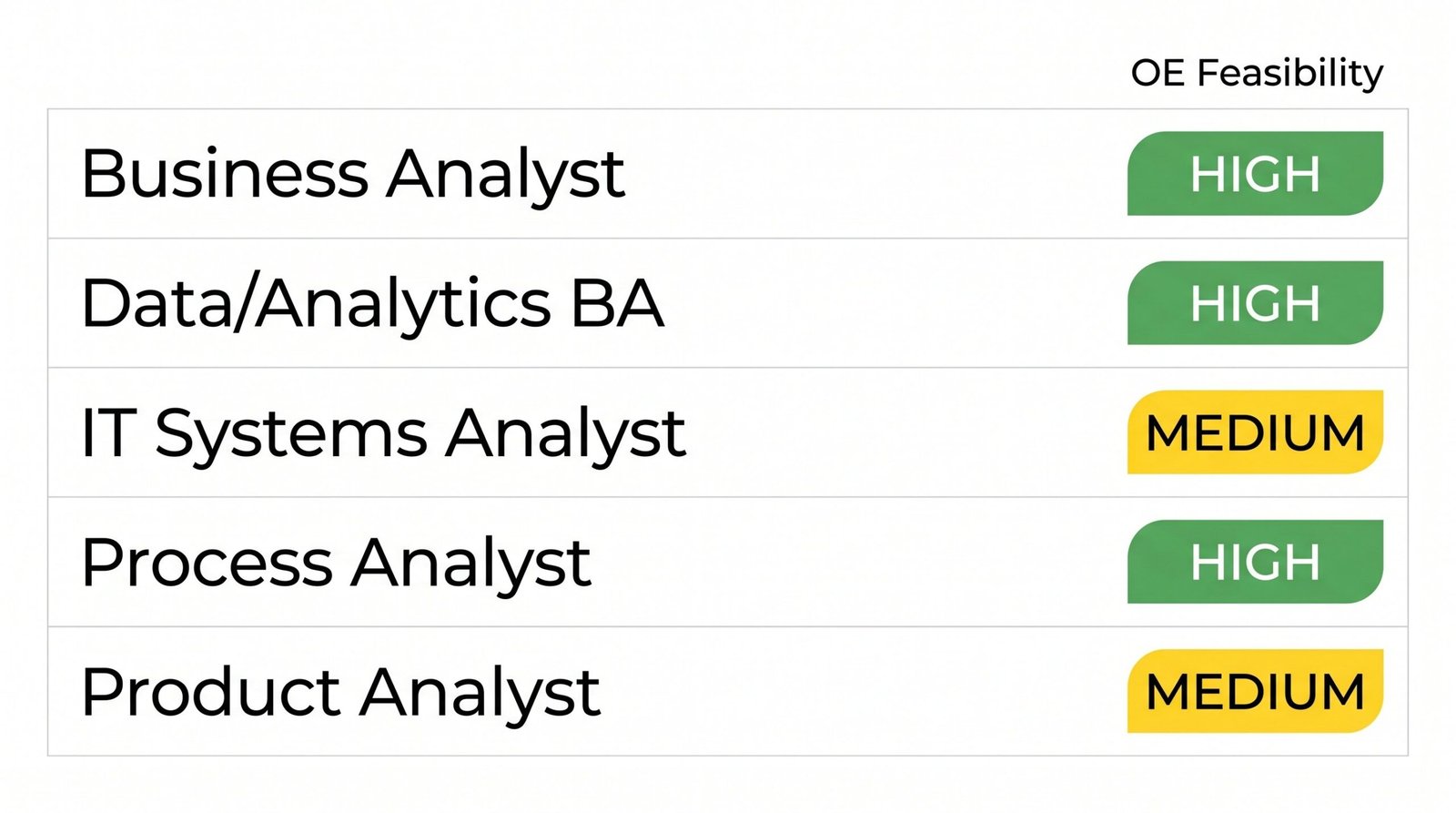
The two clearest wins for OE are Data/Analytics BAs and Process/Operations Analysts. Data BAs spend the majority of their time in SQL, dashboarding tools like Tableau or Looker, and Python or R notebooks. Output is queries, dashboards, and analysis decks. Meetings are typically weekly check-ins with a business stakeholder plus a tech review. The tooling stack at one company often does not overlap with another. A BA running J1 in Snowflake and J2 in BigQuery has near-zero tool overlap risk. Meeting loads in this role often sit under ten hours per week once you are past onboarding. Once you have the SQL chops and domain knowledge, the actual production of analysis is fast.
Process Analysts and Operations Analysts are similar in profile. The work involves interviewing process owners, documenting current state, identifying pain points, and proposing future state. The cadence is project-based and the deliverables are documents and diagrams. Stakeholder interviews are scheduled, and once you have the interviews complete, the documentation work is heads-down and async. If you have ever run a process improvement project, you know that the bulk of the work is between meetings, in your own head, organizing what you have learned and figuring out how to represent it cleanly. This is exceptional fit for OE because the bulk of the work is invisible to anyone who is not looking at the artifact itself.
IT Systems Analysts sit at the lower end of feasibility because the role typically sits inside an engineering team and operates on a sprint cadence. Daily standups, sprint planning, sprint reviews, retrospectives, and frequent technical design sessions add up to a meeting load that can hit twenty hours per week. The role also has higher tool overlap risk because IT Systems Analysts work directly in Jira, often share screens during technical reviews, and may have access to source control systems where their identity is more exposed. Some IT Systems Analyst roles are doable as OE, particularly those at companies running quarterly planning rather than two-week sprints, but the average is harder than the other BA flavors.
Product Analysts sit in the middle. The role is essentially product management lite or product management’s left hand. You work closely with PMs, engineers, and designers on feature definition, user research synthesis, and metrics analysis. Meeting loads vary wildly by company. A Product Analyst at a small startup might be in standups daily. A Product Analyst at a larger company on a mature product might attend two or three meetings per week and otherwise be heads-down. The fit depends on how the team is structured.
The Real OE Risks for Business Analysts
Most OE risks are universal to remote knowledge work. The risks specific to business analysts are concentrated in tooling, document fingerprints, and the unpredictable nature of discovery work. Let’s walk through each.
Jira and Confluence footprints. Atlassian is the dominant BA tooling stack and it is also the riskiest from an OE exposure standpoint. If both of your employers run Jira Cloud and Confluence, your Atlassian account is keyed to an email address. If you use the same personal email across both Atlassian accounts, or worse use one corporate email at one job and that same email gets surfaced in cross-company integrations, your activity could in theory be cross-referenced. The mitigation is simple but non-negotiable: each employer’s Atlassian instance gets its own corporate email. Never use a personal email on an employer’s Atlassian. If you maintain personal Atlassian accounts for community work or open source, keep those entirely separate from anything related to either employer. Many BA tools sync to corporate email by default, so if J1 has Workday provisioning that auto-creates Jira accounts from your J1 email, you are fine. You only get into trouble if you start authenticating with shared personal credentials.
Scheduling conflicts in requirements sessions. The headline meeting load for a BA might be reasonable, fifteen or twenty hours per week. The actual constraint that bites OE BAs is the unpredictability of stakeholder interviews and discovery sprints. A typical BA week might have four meetings scheduled, all comfortably in async-friendly windows. Then a senior stakeholder reaches out about a new initiative and wants three hour-long interviews this week. Now suddenly your J1 calendar has seven meetings clustered Tuesday through Thursday, and J2’s standup at 10am Wednesday is impossible. A BA who goes dark or repeatedly reschedules during a critical discovery sprint gets noticed. The fix is to build calendar slack into both jobs. Block out 90-minute windows on each calendar that are unbookable. Use those blocks as buffer for the other job. Most calendar tools let you set this up with recurring busy time. If you cannot maintain at least a 20% buffer on each calendar, you will eventually get stuck in a collision.
Document and artifact style fingerprints. This is the one most people underestimate. As a working BA, you have developed a documentation style. You like a certain font, you organize your BRDs a certain way, you name files using a convention you have polished over years. If you use the same templates, the same fonts, and the same naming conventions across both companies, you have a fingerprint. A hiring manager who reviewed your work at J1 last year and now lands at J2 could open one of your requirements documents and think “wait, this looks familiar.” Vary your styles intentionally. Use one employer’s official templates whenever they exist. Adopt different fonts for any documents you create from scratch. Use different folder organization. Some OE BAs maintain a “style guide” for each employer in their own private notes so they remember which conventions to apply where.
LinkedIn exposure during the overlap period. Like every OE role, the concurrent employment period is when you are most exposed. The standard playbook applies: do not list overlapping concurrent roles on LinkedIn. Keep your current employer field accurate to whichever of your two jobs has been your tenure longer, or to whichever you would publicly claim if asked. Set your profile to private from non-connections, restrict who can see your activity feed, and never accept connection requests from coworkers at J2 unless they are well outside your reporting chain. Your LinkedIn is more dangerous than your Jira activity because it is searchable by anyone, including recruiters who might mention to a hiring manager that “your new BA also works at X.” The legal framework around outside employment is worth understanding, and the NLRB protections for employees with outside work give you a sense of the baseline rights you have, though those rights vary by state and by your specific employment contract.
Background check exposure. The biggest myth in OE is that your employer is constantly running background checks on you. They are not. Employment verification services like The Work Number check pay stubs and tax records, but those checks happen at hire and occasionally at promotion, not on a rolling basis. The IRS knows you have two W-2s because both employers report your earnings to the IRS. Your employers typically do not get visibility into that unless they run a background check during your employment, which is rare but not unheard of in regulated industries like finance, defense, or healthcare. If you work in a regulated industry, do your own diligence on how often your employer runs verification checks. Some financial services firms run them quarterly. Tech companies almost never do.
The legal context around all of this is worth a minute. Working two jobs is legal in almost every U.S. jurisdiction. The risk is contractual, not criminal. Your employment contract may have a moonlighting clause or an exclusivity clause that, if violated, gives the employer grounds to terminate you for cause. Termination for cause is the real cost, not legal liability. The employment relationship under U.S. law is at-will in most states, which means either party can end the relationship for nearly any reason or no reason. A moonlighting clause typically operationalizes the employer’s right to terminate if they discover concurrent employment. Whether they would actually exercise that right depends on the company, the relationship, and the circumstances. If you want the long-form treatment of this, we have a dedicated piece on whether overemployment is legal that gets into the contractual specifics.
Tool Isolation Strategy for BAs
Now to the practical stuff. Tool isolation is the operational hygiene that keeps your two jobs from leaking into each other. The good news is that BA work happens in browsers and document tools, so the isolation patterns are straightforward.
Start with browsers. Use separate browsers for each employer. Chrome profile for J1. Firefox for J2. Or Chrome for J1 and Edge for J2. The specifics matter less than the separation. Each browser maintains its own cookies, its own saved logins, its own extensions, and its own browsing history. When you sign into Confluence for J1, that session lives in the J1 browser. When you sign into Confluence for J2, it lives in J2’s browser. There is no cross-contamination, no risk of accidentally clicking the wrong tab during a screen share, and no risk of an auto-fill suggesting a J1 credential while you are signed into J2.
Some people use Chrome profiles instead of separate browsers. That works if you are disciplined, but the failure mode is bad. If you screen share and the wrong profile is selected, you have a problem. Separate browsers make the isolation visually obvious and reduce the chance of human error during a tense moment like a live screen share with stakeholders.
Separate Jira and Confluence accounts tied to separate email domains is the rule. J1 corporate email maps to J1’s Atlassian account. J2 corporate email maps to J2’s Atlassian account. Never use a personal Gmail for an employer’s Atlassian account. If you have personal Atlassian accounts for community work, keep those on a third email, not on either employer’s email.
Store deliverables in employer-provided storage only. OneDrive for J1, Google Drive for J2. Never store work artifacts on personal cloud accounts. Beyond being a security violation in most employment contracts, personal storage creates a single attack surface where artifacts from both employers could end up in the same folder structure. If you ever needed to give an employer access to your personal storage, say for a forensic review, you would be exposed. Keep employer work on employer systems.
Different naming conventions for documents at each employer is part of the fingerprint mitigation we discussed. If you naturally write file names like “BRD_ProjectName_v2_2026-01-15,” use that convention at J1 only. At J2, switch to something like “Requirements – Project Name (Draft 2)” or whatever the employer’s house style is. Adopt the local convention. This is not about being creative, it is about being unrecognizable.
If both employers use Microsoft Office or Google Workspace, file metadata is a real exposure. Word documents contain author metadata, last-edited-by fields, and sometimes the Microsoft account email that created the document. Google Docs files contain the account that owns the document and the accounts that have edited it. If you create a document on J1’s Office instance and then share it with someone who, hypothetically, moves to J2, they can open the file properties and see your J1 corporate email as the author. Mitigation: save as PDF before sharing externally whenever possible. PDFs flatten most metadata. For internal collaboration where you need the live document, the metadata is fine because it is your J1 identity inside J1. The risk is when documents leave the employer environment.
Two more practical notes. First, use separate password managers or separate password manager vaults for each employer. 1Password and Bitwarden both support multiple vaults per account, but the simplest approach is to keep your J1 password manager logged in on J1’s browser only, and J2’s password manager logged in on J2’s browser only. Second, use separate calendar applications for each job. If both employers use Google Calendar, your J1 calendar is one tab in J1’s browser and J2’s calendar is a tab in J2’s browser. Do not aggregate them. The temptation to use a tool that combines both calendars in one view is real, especially when you are juggling, but that one combined view is a fingerprint risk and an isolation breach.
The Dual-BA Income Math
Here is the part people came for. What does running two BA jobs actually pay? The numbers vary by experience level, geography, industry, and the specific role flavor, but the ranges below are accurate for the U.S. market entering 2026. These are W-2 base salaries before bonuses or equity.
- Entry-level BA (0-2 years): $65,000 to $80,000
- Mid-level BA (3-5 years): $85,000 to $105,000
- Senior BA (6+ years): $110,000 to $135,000
- IT/Systems Analyst (mid to senior): $95,000 to $115,000
- Data/Analytics BA (mid to senior): $100,000 to $125,000
These ranges assume remote roles at U.S. companies of reasonable size. Big tech and major financial services will pay higher than these ranges. Smaller companies and regional consultancies pay lower. The dual-job income scenarios below use mid-range numbers at each level.
| Scenario | Single Job Income | Dual-Job Total |
|---|---|---|
| Entry level x2 | $70,000 | $140,000 |
| Mid-level x2 | $95,000 | $190,000 |
| Senior x2 | $120,000 | $240,000 |
| Senior + Contract (1099 C2C) | $120,000 + $130,000 | $250,000 (no benefit cost sharing) |
The numbers speak for themselves. Two mid-level BA salaries put you at $190K. Two senior BA salaries put you at $240K. The senior plus contract scenario is interesting because a 1099 C2C arrangement at $130K provides a separate business entity that adds privacy, but you lose the employer-paid benefits on that role, so the gross is higher and the net comparison depends on your benefit valuations.
The tax implications of dual W-2 income are significant and frequently misunderstood. Both employers withhold federal income tax based on their payroll system treating your job as if it is your only source of income. The W-4 withholding formula assumes you have one job and applies the relevant tax brackets accordingly. When you have two W-2s totaling $190K, both employers are withholding as if you make their respective $95K, but your actual marginal tax bracket is calculated on the combined $190K. The result is consistent under-withholding, often by thousands of dollars across the year. You will owe at tax time unless you proactively adjust withholding. IRS Publication 505 on tax withholding walks through the multiple-employer scenarios and provides worksheets for calculating the correct additional withholding to apply on each W-4. Read it once at the start of the year, adjust your W-4s, and you will avoid the surprise April bill.
Beyond federal withholding, watch for Social Security overpayment. Each employer withholds Social Security up to the annual wage base limit. If both employers withhold the full amount because each thinks you are only earning their salary, you may have overpaid into Social Security. The good news is this is automatically reconciled when you file your federal return. The IRS credits the excess Social Security back to you. You do not need to do anything special at the employer level. State taxes work similarly to federal, with the wrinkle that some states have specific rules around multi-state remote work if your employers are headquartered in different states.
On the C2C path, the math gets more complex. As a C2C contractor through your LLC, you are billing at an hourly rate, your LLC pays you a salary or distributions, and the LLC handles its own tax obligations including quarterly estimated payments and self-employment tax. You also lose access to employer-paid health insurance, employer 401(k) match, employer-paid disability and life insurance, and paid time off. The hourly rate has to absorb all of that. Generally, a C2C BA rate of $80-$110 per hour translates to roughly $140K-$200K annualized at full utilization, and after benefit replacement costs the net comparison to a $120K W-2 is closer than the headline number suggests. The privacy of a separate business entity matters more for some people than for others.
How to Land Your Second BA Role
The hardest part of OE is usually landing J2 while J1 is in good standing. The interviews are easier than your first BA interview because you have current experience and recent context. The harder part is finding the right J2: a role that fits your async-first OE strategy without raising flags during the interview process.
Start by prioritizing async-first companies. The signal is usually visible in the job description. Look for explicit mentions of asynchronous communication, written documentation culture, or distributed teams across time zones. These are companies that have built process around async work because they had to, and that process protects you. Companies like GitLab, Zapier, Doist, and many smaller remote-first startups make their async culture a feature in recruiting. If you can find one of these as J2, your meeting load will be light by default.
Conversely, avoid BA roles at companies that emphasize “heavy collaboration,” “cross-functional sprint ceremonies,” “frequent stakeholder engagement,” or “in-person hybrid presence” in their job descriptions. These phrases are signals of high synchronous load and are non-starters for OE. Even if the role is technically remote, the meeting expectations will eat your time and create scheduling collisions with J1. Pass on these and keep searching.
Job boards have different strengths for BA roles. LinkedIn is the largest aggregator but also the most competitive. Set the filter to remote only and apply early. Dice.com has strong listings for IT Systems Analyst and Data BA roles, particularly in financial services, healthcare, and government contracting where Dice has historical strength. Toptal is worth considering for contract BA work, particularly for a C2C structure as J2. Toptal vets candidates upfront, which makes the matching better but the entry barrier higher. Other places worth checking include WeWorkRemotely, AngelList (now Wellfound) for startup roles, and Built In for tech hubs.
The W-2 versus C2C decision for J2 deserves real thought. A second W-2 is simpler. You apply, you interview, you get an offer, you onboard. The tax filing is straightforward, you keep the employer-paid benefits, and you can hit the ground running. The downside is that a second W-2 creates a paper trail that, in theory, could surface through employment verification services. A C2C contract role provides more privacy because your contract is between your business entity (LLC or S-corp) and the client, not between you personally and the client. Your name appears, but the structure shields you from the standard employment verification pipeline. C2C also typically pays a higher gross rate but requires you to handle your own benefits, taxes, and time off. For experienced BAs who have done some contracting before, C2C as J2 can be appealing. For someone new to OE, a second W-2 is simpler.
The interview question that buys you intelligence without raising flags is one you should already be asking: “How does your team handle async communication?” This is a standard remote work question. Every candidate at an async-first company asks it. The answer tells you a tremendous amount. If the hiring manager talks about Loom videos, async standups in Slack threads, written status updates, and tools like Notion or Linear that support async-first workflows, you are in good territory. If the hiring manager says “well, we have a lot of meetings because that is how we collaborate,” you have your answer too, just the wrong one.
Pace your interviews. Do not try to land J2 in the middle of a major delivery at J1. The OE veterans on r/overemployed often describe their J2 hunt as a slow, patient process rather than a sprint. You are looking for the right fit, not the first offer. If J2 has the wrong calendar profile, you will struggle for months. Better to wait for the right role. For the full playbook on the hiring side of all of this, including resume strategy, interview prep, and onboarding tactics, our piece on how to become overemployed walks through everything end to end.
One more note on the role mix. If you have project management experience as well as BA experience, the overemployed project manager guide covers an adjacent path. Some people run J1 as a BA and J2 as a PM, or vice versa. The skillsets overlap enough that you can credibly position for either, and the role mix can actually reduce calendar overlap because the natural rhythms of the two roles differ slightly. PM work has more sprint ceremonies. BA work has more deep document time. The two together can fit cleanly if you pick the right J2.
Frequently Asked Questions
Is it legal to work two business analyst jobs at the same time?
Yes for most situations. Working two W-2 jobs is legal in almost every U.S. state, but your employment contracts may include moonlighting clauses or exclusivity provisions that, if violated, give your employer grounds to terminate you for cause. The risk is contractual, not criminal. For the long-form treatment of contracts, state laws, and what constitutes a meaningful violation, see our piece on whether overemployment is legal.
How many hours does a typical BA role take per week?
Thirty to forty-five hours in most remote BA roles, but discovery sprints and project kickoffs can spike to fifty or more. The real OE risk is not average hours but peak-load unpredictability. A normal week might be twenty-five hours of actual focused work and ten hours of meetings, but a critical week in mid-project could double both numbers. Building calendar slack for these peaks is how OE BAs survive without slipping.
Can my employer see that I have two jobs?
Not through Jira or Confluence activity alone. Employment verification services like The Work Number check pay records and tax documents, not software access logs or messaging app activity. The IRS knows you have two W-2s because both employers report your income, but employers typically do not see that data unless they run a mid-employment background check, which is uncommon outside of regulated industries. For more detail on what employers can and cannot check, see our companion guide.
What happens to my taxes if I earn two BA salaries?
Both employers withhold federal income tax based on their payroll system treating your job as if it is your only income, which often leads to significant under-withholding at tax time. You will owe in April unless you proactively adjust your W-4s. IRS Publication 505 on tax withholding includes worksheets for the multiple-employer scenario and shows how to calculate additional withholding for each W-4. If you are weighing a contract structure for J2, our C2C versus W-2 breakdown covers the tradeoffs.
Which BA tools are safest to use across two jobs?
Any browser-based tool works fine with separate browser profiles. The riskiest overlap is the Atlassian suite, because if both employers use Jira Cloud and Confluence, your Atlassian account email could in theory be cross-referenced across instances. Use a separate corporate email tied to each employer’s Atlassian, never a personal email, and keep any personal Atlassian accounts on yet a third email entirely.
Is data analyst or business analyst better for OE?
Both are viable. Data analysts face SQL access log risks that traditional BAs do not, since most data warehouses log every query against your user account. BAs face higher meeting loads than data analysts in many organizations. The data analyst role is heads-down with periodic stakeholder syncs, while the BA role is interview-heavy in early project phases. See our overemployed data analyst guide for the full side-by-side.
If you are weighing whether OE is right for you more broadly, our overview on working two remote jobs covers the lifestyle and operational reality across roles. And if you want a broader ranking of role feasibility, our role feasibility rankings places BA work in context against engineering, product, and other knowledge work paths.
RELATED POSTS
View all

Overemployed Health Insurance: Dual Coverage Guide 2026
December 22, 2023 | by overemployedtoolkit.com
Overemployed DevOps Engineer: The Honest Feasibility Guide for 2026
May 25, 2026 | by Ian Adair

How to Become Overemployed: A Step-by-Step Guide for 2026
May 12, 2026 | by Ian Adair