

The Senior PM with a Toddler
A senior PM at a healthcare SaaS company started J2 at a fintech firm during a slow Q4 at J1. She used J1’s 9 a.m. stand-up as her morning anchor and scheduled J2’s stand-up at 10:15 a.m., negotiating it as her availability window. She used Reclaim.ai to defend three two-hour focus blocks per week per job. By month four, she was pulling $310K combined and her J1 manager promoted her, citing “exceptional output consistency.” Her toddler still naps from 1 to 3, which is her hardest focus window.
Overemployed Project Manager: Why PMs Are Built for OE (And How to Do It Right)
May 19, 2026 | by Ian Adair

Overemployed Project Manager: Why PMs Are Built for OE (And How to Do It Right)
Project management may be the single most overemployment-friendly career on the market. The same skills that earn you a paycheck running one team, async communication, calendar discipline, written documentation, stakeholder management, are precisely the skills you need to quietly run two of them. Most OE guides assume you are a software engineer building features in stealth. This one is for the PMs, scrum masters, and program leads who already know how to juggle ten stakeholders and want to know if they can juggle two payrolls.
Quick Answer
Yes, a project manager can absolutely hold two remote jobs simultaneously, and PMs are arguably better positioned for OE than most roles. Your skillset already covers context switching, async updates, and meeting orchestration. With careful calendar blocking, separate hardware, and a J1 versus J2 priority structure, two remote PM roles is realistic and lucrative, typically pushing total comp from $130K to $260K or more.
Yes, a project manager can absolutely hold two remote jobs simultaneously, and PMs are arguably better positioned for OE than most roles. Your skillset already covers context switching, async updates, and meeting orchestration. With careful calendar blocking, separate hardware, and a J1 versus J2 priority structure, two remote PM roles is realistic and lucrative, typically pushing total comp from $130K to $260K or more.
Why Project Managers Are Uniquely Suited for Overemployment
Most jobs require deep, uninterrupted output. Engineers ship code. Designers produce artifacts. Writers generate copy. Project managers, by contrast, are paid to coordinate other people’s work. That structural difference is the whole reason an overemployed PM can survive where an overemployed individual contributor would burn out by week three.
The day-to-day work of a PM is fragmented by design. You hop between stand-ups, write a Confluence update, ping a dev on Slack, build a Gantt chart, review a status report, and join a stakeholder review. Each of those tasks is bounded. None of them require six straight hours of focus. That fragmented rhythm is exactly what dual employment demands. If you can already context-switch ten times a day across one team, you can context-switch twenty times a day across two.
If you are new to the concept, take a few minutes to read what overemployment means before going further. The rest of this article assumes you already understand the J1 and J2 framing.
Async-First Communication, PMs Already Live Here
Modern PM work is overwhelmingly asynchronous. Most of your output is written: status reports, RAID logs, sprint summaries, executive updates, change requests, retrospectives. A senior PM who already operates async-first does not need to invent a new working style for OE. They just need to apply existing habits to a second org chart.
Async-first PMs typically batch communication. You respond to Slack threads in 15-minute windows, not continuously. You publish a single morning status doc instead of fielding five separate “any updates?” pings. You move synchronous meetings to written equivalents whenever possible. Each of those habits compresses your visible workday and creates the white space you need to attend to a second employer.
Documentation Discipline Protects You
PMs are paid to write things down. Every project has a charter, a scope document, a risk log, a stakeholder map, a status cadence. This documentation discipline does two things for the overemployed PM: it makes your work visible without requiring your live presence, and it lets you reconstruct context fast when you return to a project after focusing on the other job.
The OE PMs who fail are typically the ones who try to hold project state in their heads. The ones who succeed write everything down, often using their own private notes layer that mirrors the official tools. When you have two RAID logs to maintain, the only way to keep them straight is to treat your own brain as untrustworthy and offload everything to systems.
Meeting Management Skills Reduce Exposure
A senior PM does not attend every meeting on their calendar. They delegate, decline, send a deputy, or convert the meeting to a written brief. That same political muscle is what lets you say “I cannot make this, please send notes” without raising eyebrows. An IC engineer who declines meetings looks suspicious. A PM who declines meetings looks like a PM.
We suggest using your meeting hygiene skills offensively for OE. Audit your J1 calendar every Friday. Decline anything that does not require you specifically. Convert recurring meetings to async updates whenever you can justify it. Each declined hour is an hour you can spend on J2.
Setting Up Your Dual-Job PM System
The infrastructure decisions you make in the first two weeks of J2 will determine whether OE works for you or blows up in your face. Most PMs spend three months planning a software rollout but try to set up dual employment in a weekend. Treat your OE setup like a real project. Define your phases, your dependencies, your risks.
J1 vs J2, Which Job Gets Primary Attention
One job has to be the primary. Trying to give equal attention to both is the most common reason OE PMs get caught. Your primary, usually J1 because it has tenure and benefits, gets your real calendar, your in-person quarterly visits if any, and your most visible deliverables. J2 gets engineered around J1.
The exception: if J2 pays substantially more and has lighter oversight, flip the priority. The job with the biggest delta between compensation and required hours should get the larger share of your defended focus time. Run the math on dollars per hour of actual attention required, not headline salary.
The Separate Everything Rule (Devices, Calendars, Profiles)
Two of everything. Two laptops, two phones (or one personal phone and one work phone per job), two browser profiles, two password managers, two VPN setups, two Slack workspaces with distinct notification rules. The instant you let the systems bleed, you risk a shared notification, a paste from the wrong clipboard, or a screen share that exposes the other employer’s tabs.
Specific setup we suggest:
- J1 laptop: company-issued, used only on J1 network, never logged into J2 anything
- J2 laptop: company-issued or personal, separate physical desk position if possible
- Personal phone: used for 2FA only, never installed with J1 or J2 work apps
- Browser profiles: dedicated Chrome or Firefox profiles per job, color-coded so you can see at a glance which one is active
- Calendars: never on the same screen at the same time; use Reclaim.ai or Motion to sync availability one-way without exposing details
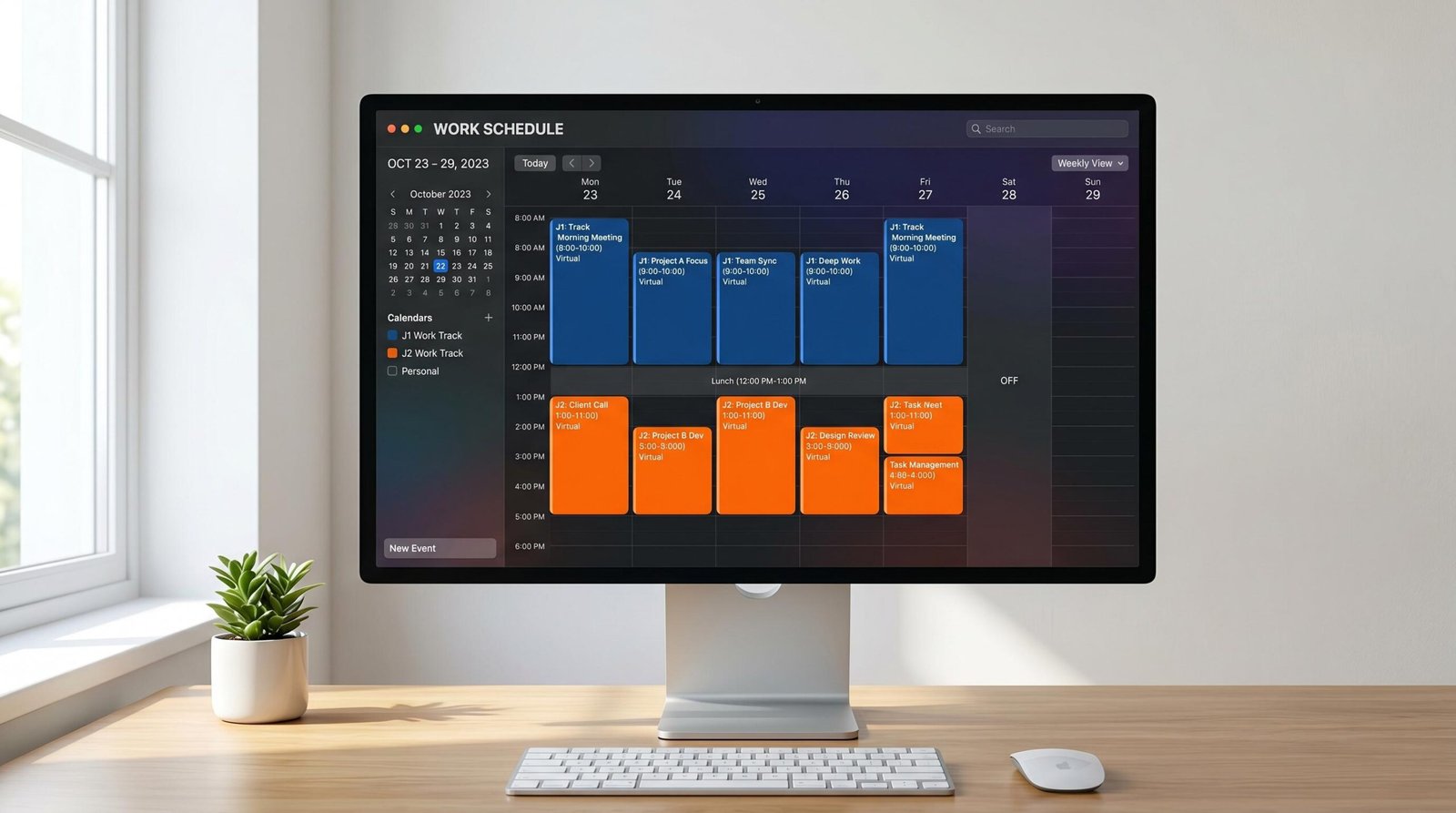
Calendar Blocking for Two Standups
Most engineering teams hold a 9:15 or 9:30 daily standup. If both your jobs do this, you have an unavoidable conflict. The fix is to negotiate one of them to a different time, frame it as “blocking deep focus for the team,” or to push for an async standup tool like Geekbot or Range. PMs have the authority to suggest these changes, which is another structural advantage you should use.
For the meetings you cannot move, build a buffer rule: never schedule anything in the 10 minutes before or after a critical meeting. That buffer is your context-switch zone, where you close J1 tabs, switch laptops, and load the relevant J2 project state into working memory. Skipping the buffer is how you end up referencing the wrong product name in front of the wrong stakeholder.
The PM Toolkit for Managing Two Jobs
You cannot run two PM jobs on memory and goodwill. You need a tooling stack that lets you offload context, automate updates, and compress meetings.
Notion or Confluence for Parallel Project Tracking
Whatever your employers use, you also need a personal layer above both. Most OE PMs use Notion (because it is fast and visual) or Obsidian (because it is local and private) to maintain a parallel dashboard. This is not for your employers. It is for you, the operator running both gigs.
Your personal dashboard typically includes: a project list per job, an active stakeholder map per job with personality notes (“hates long meetings, loves bullet points”), a deliverable calendar showing both jobs side by side, and a daily journal where you note what you said you would do for each job that day. The journal is the killer feature. When J1 stakeholder asks Wednesday “did you follow up with finance?”, you can check Tuesday’s entry instead of guessing.
Status Updates That Buy You Time
A good status update buys you a week of cover. Write a tight, specific Friday update that names the next three deliverables and their owners, and your manager will not ping you for status until next Friday. Write a vague “things are progressing” update and you will get pinged daily.
The OE PM’s status update formula: one sentence on overall health (green, yellow, red), three bullets on what shipped this week, three bullets on next week’s commitments with named owners (not always you), one risk with mitigation. That template is fifteen minutes to write and signals competence so loudly that nobody questions your engagement.
AI Tools That Compress Your Meeting Time
AI meeting tools have done more for OE than any other recent technology. The current 2026 stack most OE PMs run includes:
- Otter.ai or Fireflies: records and transcribes meetings you join, generates summaries automatically. You can attend at 70% attention and recover the rest from the transcript.
- Granola or Fathom: generates meeting notes in real time, integrates with your task tracker. Useful when J1 and J2 have back-to-back syncs and you need clean handoffs to your private dashboard.
- Claude or ChatGPT: drafts your status reports from raw notes, rewrites Slack messages to match each job’s tone, summarizes long threads when you return after a focus block on the other job.
- Reclaim.ai or Motion: auto-blocks focus time around your real meetings, defends your calendar from optional creep.
One caution: never connect a third-party AI tool to a J1 calendar or document store without checking the employer’s data policy. Some companies forbid external AI integrations. Run them on your own infrastructure when possible, or take notes manually and feed them to a personal AI after the fact.
Time Allocation: A Realistic Weekly Schedule
Here is a realistic week for an overemployed senior PM with J1 as the primary role and J2 as a lighter-touch second job. The schedule assumes both jobs are US-based with overlapping hours, which is the harder version of OE. If your J2 is in a different time zone, the math gets easier.
| Time Slot | Monday | Tuesday-Thursday | Friday |
|---|---|---|---|
| 8:00 – 8:30 | J1 inbox triage, weekly priority setting | J2 inbox triage, async standup post | J1 weekly status doc drafting |
| 8:30 – 9:30 | J1 sprint planning (recurring) | J1 stand-up + 30 min focus block | J2 retro or weekly sync |
| 9:30 – 11:00 | J1 stakeholder calls | J2 focused work block (project updates, RAID log, documentation) | J1 demos and reviews |
| 11:00 – 12:00 | J2 quick syncs (1:1s, short check-ins) | J1 mid-day check-in, Slack response window | J2 status doc + Slack response window |
| 12:00 – 1:00 | Lunch + context switch buffer | Lunch + dashboard update (personal) | Lunch + week-in-review (personal) |
| 1:00 – 2:30 | J1 deep work (planning docs, roadmap) | J1 meetings (stakeholders, leadership) | J1 wrap-up + Friday update |
| 2:30 – 4:00 | J2 stakeholder review or working session | J2 deep work block (analysis, planning) | J2 wrap-up + Friday update |
| 4:00 – 5:00 | Shared Slack response window (both jobs) | Buffer / overflow meetings / 1:1s | Personal admin (taxes, banking, OE infrastructure) |
| 5:00 – 5:30 | End-of-day notes to personal dashboard | End-of-day notes, prep for tomorrow | Off, hard stop |
The pattern: Monday is heavy planning so both jobs get oriented for the week. Tuesday through Thursday alternate focus blocks with batched meetings. Friday is wrap-up, status documents, and personal admin. A disciplined OE PM working this rhythm puts in roughly 50 to 55 hours per week of actual work, not 80. The trick is not working twice as hard, it is removing dead time from both jobs.
The Biggest Risks for OE Project Managers (And How to Manage Them)
OE is not risk-free. Most of the risks are predictable and manageable if you treat them as a project itself. The PMs who get caught usually ignored an obvious risk that was visible from week one. PMs who plan for it last for years.
The Availability Problem, When Both J1 and J2 Need You at Once
Sooner or later, both jobs will want you on a call at the same time. A production incident, an executive review, a customer escalation. You cannot be in two places. You need a pre-built response pattern.
The pattern most OE PMs use: J1 always wins for true emergencies (you have tenure and benefits there), but J2 must be told “I am on a critical call, will respond in 45 minutes” within five minutes of the conflict. The worst response is silence. The second worst is “I am sick” because if it happens twice, your reputation degrades. Confident, specific deflection beats vague unavailability every time.
Deliverable Overlap, Managing Competing Deadlines
Quarter-end is the danger zone. Both jobs typically push deliverables in the same two-week window. The fix is to look six weeks ahead, not two. Map every major deliverable across both jobs onto a single private Gantt chart. When you see two ship dates on March 31, you have six weeks to renegotiate one of them or accept that you will be working weekends.
Senior PMs are good at saying “we can hit that, but we’d need to move X out two weeks.” Use that muscle on both jobs. Renegotiation is a normal PM activity, not a red flag. If you only ever say yes, you will eventually fail to deliver, and that is when OE collapses.
Context Switching Fatigue
Two PM jobs is mentally heavier than two engineering jobs because PMs hold relationships in memory, not just code. You remember that Sarah at J1 prefers Slack and Mark at J2 prefers email. Mixing them costs you credibility. Context switching at this depth is exhausting.
We suggest building three recovery habits: a hard end-of-day shutdown ritual (close all tabs, log out, walk away from the desk), a real lunch break with no screens, and one full day per week with no work at all. The OE PMs who run hot for six months and then crash for two are usually the ones who skipped recovery time. The ones who sustain OE for three or four years treat recovery as a non-negotiable input.
OE Project Manager Income: What You Can Actually Earn
The financial case for OE PM work is straightforward. PM salaries cluster in a relatively narrow band for each seniority level, which means a second role typically nets close to the first one. Unlike senior engineers who sometimes take a pay cut for a quieter J2, PMs tend to find that two equivalent roles pay roughly the same.
Average PM Salaries (by seniority + specialty)
According to Bureau of Labor Statistics data on project management specialists, the median annual wage in the United States is comfortably into six figures, with technical and program management roles trending higher. PMI salary surveys show senior PMs and program managers in tech consistently in the $140K to $200K base range, with TPM and director-level roles pushing higher.
Specialty matters. Technical PMs at FAANG-adjacent companies, program managers at fintech firms, and senior PMs at infrastructure SaaS companies all trend above the median. Construction PMs, healthcare PMs, and traditional waterfall PMs at non-tech firms cluster lower.
Total Compensation With Two Roles (realistic figures)
| PM Seniority | Average Single Salary | OE Potential (2 Roles) | Net After Taxes (est.) |
|---|---|---|---|
| Junior PM (1-3 yrs) | $75,000 | $140,000 – $160,000 | ~$98,000 – $112,000 |
| Mid-Level PM (3-6 yrs) | $115,000 | $220,000 – $240,000 | ~$150,000 – $165,000 |
| Senior PM (6-10 yrs) | $145,000 | $270,000 – $310,000 | ~$180,000 – $205,000 |
| Principal/TPM | $185,000 | $340,000 – $400,000 | ~$220,000 – $260,000 |
| Program/Director PM | $220,000 | $400,000 – $470,000 | ~$255,000 – $295,000 |
These are illustrative figures, not promises. Net-after-tax numbers vary substantially by state and filing status. With two W-2 jobs, your tax withholding will under-withhold by default, and you should plan for either quarterly estimated payments or a manual W-4 adjustment. The IRS tax withholding estimator handles the two-job calculation if you input both W-2 incomes.
Stories From OE PMs (Composite Scenarios, No Names)
The Burned-Out Program Manager
A program manager at a logistics startup picked up a J2 at a quiet enterprise B2B SaaS firm. J1 was high-stress, J2 paid $165K for what he describes as “five hours of real work a week.” For six months, he was making $355K combined. Then J1 promoted him to director and the meeting load doubled. He dropped J2 within two weeks rather than let either job slip. The lesson: when J1 changes, your OE math has to change with it.
A program manager at a logistics startup picked up a J2 at a quiet enterprise B2B SaaS firm. J1 was high-stress, J2 paid $165K for what he describes as “five hours of real work a week.” For six months, he was making $355K combined. Then J1 promoted him to director and the meeting load doubled. He dropped J2 within two weeks rather than let either job slip. The lesson: when J1 changes, your OE math has to change with it.
The Quiet TPM
A technical program manager at a major cloud provider has held J2 for almost three years now, a smaller TPM role at a Series C startup. He works strict 8 a.m. to 6 p.m. hours, never logs in on weekends, and refuses any J2 opportunity that requires more than two meetings per day. Total comp clears $380K. His tactic: he selected J2 specifically for its low-meeting culture, not for the highest dollar offer. Job fit beats job pay for sustainable OE.
A technical program manager at a major cloud provider has held J2 for almost three years now, a smaller TPM role at a Series C startup. He works strict 8 a.m. to 6 p.m. hours, never logs in on weekends, and refuses any J2 opportunity that requires more than two meetings per day. Total comp clears $380K. His tactic: he selected J2 specifically for its low-meeting culture, not for the highest dollar offer. Job fit beats job pay for sustainable OE.
Not every OE story ends well. If you want a sober look at what happens when things go wrong, including legal exposure, severance implications, and the rare clawback scenarios, see this guide on what happens if you get fired while overemployed.
FAQ
Can project managers work two remote jobs at the same time?
Yes. PMs are structurally well-suited to OE because their work is asynchronous, documentation-heavy, and meeting-driven, all of which can be batched and time-shifted. Most OE PMs run two roles for one to four years before either consolidating, switching, or stepping back. The viability depends on whether both jobs are flexible enough to allow meeting deflection and async-friendly status updates.
What PM tools work best for managing two jobs?
The reliable stack is Notion or Obsidian for your private dashboard, Reclaim.ai or Motion for calendar defense, Otter.ai or Granola for meeting transcription, and Claude or ChatGPT for drafting status updates from raw notes. Use whatever your employers mandate for the public work (Jira, Asana, Monday, Smartsheet) but maintain your own layer above both.
How do OE PMs handle conflicting meetings?
The default rule: J1 wins true emergencies, but J2 gets a fast, confident deflection (“on a critical call, will respond in 45 minutes”) rather than silence. For predictable recurring conflicts like overlapping stand-ups, renegotiate one of the times or push for an async standup tool. PMs have the authority to suggest meeting changes, which most ICs do not.
Is it illegal to hold two remote jobs?
Holding two full-time W-2 jobs is not illegal in any US state. It may violate your employment contract if your employer has an exclusivity clause or a moonlighting policy. Read both contracts carefully. The consequences if discovered are typically termination of one or both jobs, not legal action. Government, defense, and certain regulated industries have stricter rules and conflict-of-interest restrictions.
What’s the biggest risk of being an overemployed PM?
The biggest risk is not getting caught, it is burning out from context switching fatigue and quietly degrading at both jobs until one of them performance-manages you out. Building recovery time, real weekends, no-screen evenings, and a hard end-of-day shutdown ritual, is more important than any operational trick.
How do I find a second remote PM job?
Treat the J2 search exactly like a normal job search: LinkedIn, Otta, Hacker News Who’s Hiring threads, and PM-specific boards like Pragmatic Engineer’s job board. Filter aggressively for fully remote, no in-person quarterly visit requirements, and small to mid-stage companies (faster hiring, less invasive onboarding). Avoid public sector and Big 4 consulting, which tend to require timesheets and exclusive engagements.
Do I need to tell my employer I have another job?
You are not legally required to volunteer the information, but your employment contract may require disclosure of outside work. Most OE PMs do not disclose. If asked directly, the calculation depends on your jurisdiction, contract language, and risk tolerance. Some OE practitioners draw the line at not lying in writing while staying silent verbally. Decide your line in advance, not in the moment.
How long can I sustain OE as a project manager?
Typical OE tenure for PMs is 18 months to 4 years. The shorter end is for people who took on OE during a financial crunch and exit once the goal is hit. The longer end is for people who optimized for sustainability from day one: lighter-touch J2, strict recovery habits, and aggressive meeting hygiene. Almost nobody runs two PM roles indefinitely, but two to three years is common and life-changing financially.
RELATED POSTS
View all

How to Read a Background Check Report: The Job Seeker’s Complete Guide (2026)
December 22, 2023 | by overemployedtoolkit.com