

Overemployed Solutions Architect: The Honest 2026 Feasibility Guide
June 5, 2026 | by Ian Adair

Overemployed Solutions Architect: The Honest 2026 Feasibility Guide
Yes, solutions architects can be overemployed, but feasibility depends heavily on the type of SA role. Cloud and internal technical SAs are nearly ideal for OE because the work is async, documentation-heavy, and project-based. Customer-facing and pre-sales SAs are harder due to scheduled workshops, demos, and LinkedIn-visible deliverables. The best fit: a Cloud SA at a mid-sized SaaS or product company.

What Is a Solutions Architect?
A solutions architect designs technical systems and translates business requirements into architecture decisions. Unlike a software engineer who writes production code daily, an SA spends most of their time producing design documents, evaluating tradeoffs, drawing diagrams, and aligning stakeholders on technical direction.
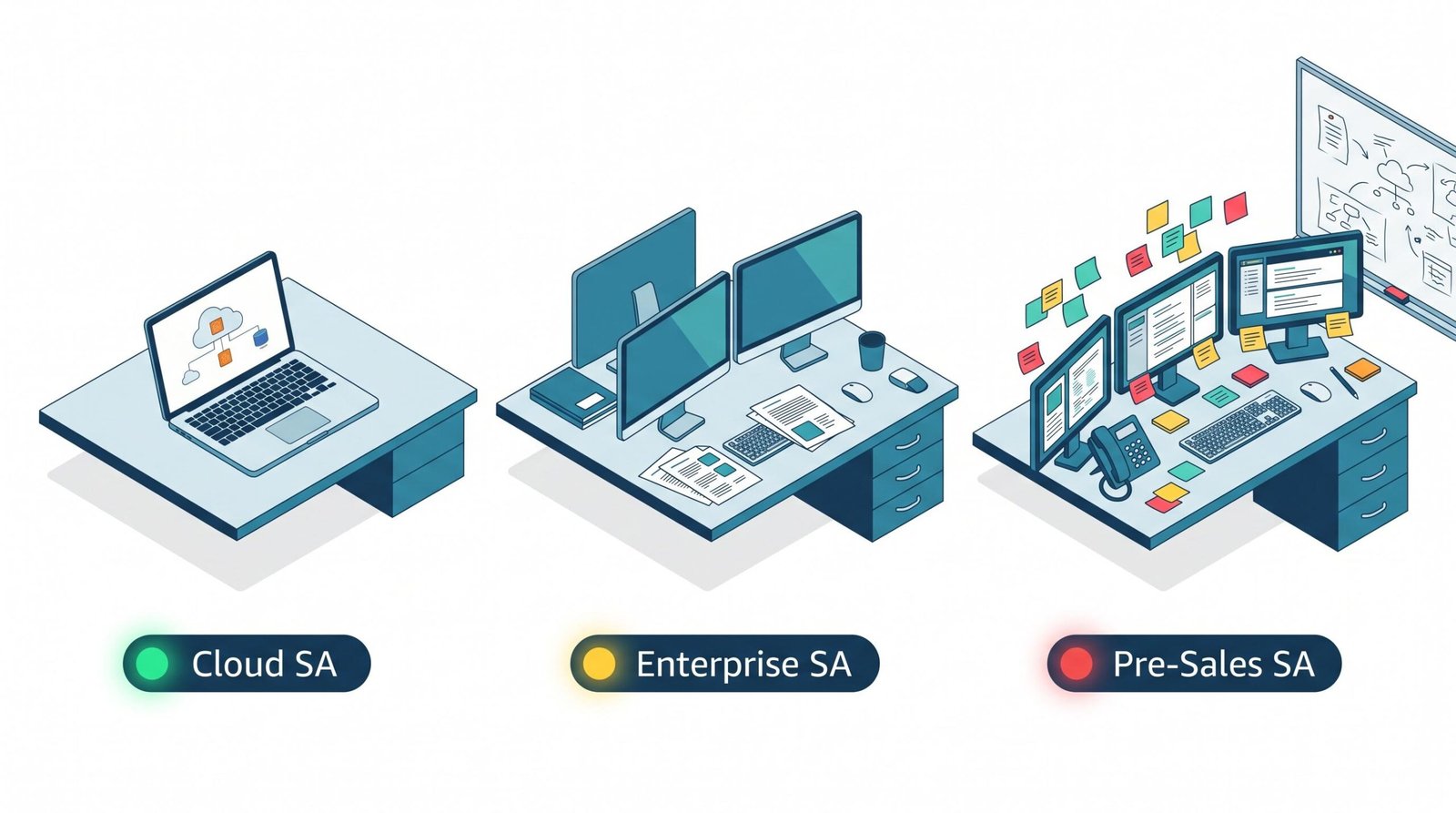
The role splits into three main flavors. Cloud Solutions Architects design AWS, Azure, or GCP deployments, usually working inside one platform’s ecosystem. Enterprise Solutions Architects sit at a higher altitude, mapping technology to business strategy across multiple departments. Pre-Sales Solutions Architects work alongside account executives, running customer workshops and producing proposals that close deals. Each flavor has wildly different OE feasibility profiles, which is why generic “is SA good for OE” answers fail readers.
OE Feasibility by SA Type
| SA Type | Remote-Friendliness | Meeting Load | Async Work % | OE Feasibility Score |
|---|---|---|---|---|
| Cloud Solutions Architect | Very High | Low to Medium | 70-80% | 9/10 |
| Technical SA (Internal) | Very High | Low | 75-85% | 9/10 |
| Staff/Principal SA | High | Medium | 60-70% | 7/10 |
| Enterprise Solutions Architect | Medium to High | Medium to High | 45-55% | 5/10 |
| Pre-Sales Solutions Architect | Medium | Very High | 25-35% | 3/10 |
Cloud SAs and internal Technical SAs land at the top of the ranking because the work product is documents and diagrams, not live performances. A reference architecture for a Kubernetes migration takes a week of focused design thinking, then a few review cycles. Nobody on either team is watching you type. You ship the artifact, attend two or three review calls, and iterate.
Staff and Principal SAs score lower because seniority brings visibility. You sit in more strategy meetings, mentor junior architects, and get pulled into escalations. The work is still mostly async, but the calendar pressure goes up.
Enterprise SAs and Pre-Sales SAs sit at the bottom because their value is measured in meetings, not artifacts. If you’re paid to be in front of executives or prospects every week, OE compresses fast.
Why Solutions Architects Are Well-Suited for OE
Documentation-Heavy Work Is Async by Nature
Solution designs, RFP responses, target-state architecture documents, proof-of-concept write-ups, and HLD/LLD docs are the bulk of SA output. None of these have a visible “I’m working right now” signal. A 12-page design document submitted Friday at 3pm looks identical whether you wrote it Monday morning or in three Saturday hours. This is the single biggest reason SAs outperform engineers at OE: the unit of work is a deliverable, not a punched-in clock.
No On-Call Rotations
SAs almost never carry pagers. Production incidents belong to SRE, platform, and devops teams. If you compare the role to an overemployed devops engineer, the difference is stark: devops folks get woken up at 3am and have to react inside SLA windows, while SAs get an email asking for a post-mortem architecture review next Tuesday. Predictable response windows are gold for anyone juggling two jobs.
Project-Based, Not Sprint-Based
Software engineering teams operate on two-week sprints with daily standups, sprint planning, demos, and retros. SAs operate on engagement cycles that run six to twelve weeks. There is no daily standup to fake. Status updates are weekly. Reviews happen at design checkpoints, not every 24 hours. The longer the cycle, the easier it is to spread work across two roles without anyone noticing.
High Income Makes the Math Compelling
According to median solutions architect salary data, U.S. SAs earn roughly $130K-$180K base, with senior roles reaching $200K+ and Staff/Principal levels above $250K total comp. Stacking two senior SA jobs puts you in the $350K-$450K range without bonuses, and into half-a-million-plus territory at the staff level. That income jump is hard to match in most knowledge-worker roles, which is part of why SA shows up on every list of viable OE careers.
The Biggest OE Challenges for Solutions Architects
Customer-Facing Calls Are Your Biggest Risk
Architecture review boards, customer workshops, vendor demos, and quarterly business reviews are the meetings that break overemployed SAs. They get scheduled weeks in advance, involve executives on both sides, and cannot be quietly rescheduled. If both jobs hand you a “must attend” customer touchpoint at the same hour on the same Tuesday, you have a problem no calendar trick can solve. We suggest gravitating toward internal-facing SA roles for at least one of your two seats.
LinkedIn Profile Exposure
SAs are a public-facing function. Marketing teams love to feature architects on case studies, conference panels, and webinars. Recruiters routinely surface SAs from both companies in the same talent pool. Treat your LinkedIn profile as one of your two work identities only, keep it minimal, and never accept connection requests from anyone in your second company’s org chart.
Certification Associations
The AWS Certified Solutions Architect credential and the Microsoft Certified: Azure Solutions Architect Expert credential are both tied to your legal name and visible on Credly, AWS Partner portals, and Microsoft Learn profiles. Some employers verify partnership tier or solutions competency designations against named individuals. If you hold a cert and both jobs require it counted against their partner status, that’s a discoverable overlap. The mitigation: pick jobs in different cloud ecosystems so the credentials each employer cares about don’t collide.
Proposal and Deadline Overlaps
RFPs and proposals are the SA’s product, and they tend to drop with two-week turnaround windows. If both employers receive RFPs in the same week, you’ll be writing 60-80 hours of dense technical content with hard customer deadlines. Build a buffer of pre-built reference architectures and reusable proposal sections so you can produce fast when both sides crunch at once.
Solutions Architect OE Income Potential
| SA Level | Single Job Salary | Two Jobs (OE) | Annual Difference |
|---|---|---|---|
| Junior SA (0-3 yrs) | $95K-$120K | $190K-$240K | +$95K-$120K |
| Mid-Level SA (3-6 yrs) | $130K-$165K | $260K-$330K | +$130K-$165K |
| Senior SA (6-10 yrs) | $170K-$210K | $340K-$420K | +$170K-$210K |
| Staff/Principal SA (10+ yrs) | $220K-$280K | $440K-$560K | +$220K-$280K |
These ranges are base salary only. Add bonuses, RSUs, and partner-tier kickers, and a doubled-up Senior SA realistically lands in the $400K-$500K total comp band. That’s the income range that pulls people into OE in the first place, and it’s why the SA role is one of the best jobs for overemployment in 2026 for anyone with the right background.
Which SA Type Is Best for OE?
The ranking, from most viable to least:
1. Cloud SA. The clear winner. Mostly async, deliverable-based, and remote-native. Cloud SAs at SaaS and product companies often have weeks where they attend three or four meetings total. The work is design docs, IaC reviews, and Slack threads. Two of these stacked together is the platonic ideal of OE.
2. Technical SA (Internal). Nearly tied with Cloud SA. Internal SAs work with engineering teams to design new systems and review existing ones. No customer pressure, no proposals, just architecture reviews and design docs. Slightly fewer roles available than Cloud SA, but when you find one, it’s a fortress.
3. Enterprise SA. Middle of the pack. The strategic altitude means you’re in more cross-functional meetings, but the work is still mostly thinking and writing. Doable for OE if you choose carefully and avoid roles with heavy presentation duties.
4. Pre-Sales SA. The worst fit. Your job is to be in front of customers. Workshops, demos, technical deep-dives, RFP defenses, all on scheduled customer time. Calendar overlap kills you. Some practitioners do it by holding one pre-sales role and one internal role, but two pre-sales seats at once is borderline impossible.
How to Manage Two SA Jobs (Practical Tips)
1. Block protected design time on both calendars. Mark 9-11am and 2-4pm as “deep work” or “architecture design” on both calendars every day. This gives you a baseline of overlap-free work blocks and trains both teams to schedule around them.
2. Stagger your meeting load. If Job A has heavy Tuesday/Thursday meetings, push Job B toward Monday/Wednesday/Friday by accepting standing calls only on those days. Most SA work is asynchronous enough that you can shape your meeting footprint.
3. When both customers want the same hour, pick the higher-stakes meeting. Send a senior peer or delegate to the lower-stakes call, or send a written architecture brief in advance and ask for async feedback. Architecture reviews can usually be handled async if you over-prepare the document.
4. Lean on async by default. Default to written design docs, Loom recordings, and shared diagrams instead of live meetings. If you set the cultural tone that you communicate in writing, both teams will adapt. This single shift can recover 5-10 hours per week.
5. Build a reusable design library. Maintain a private repo of reference architectures, proposal templates, and diagram patterns. When both jobs need a deliverable in the same week, you’re customizing 70% pre-built content instead of starting from scratch.
6. Run two completely separated machines. One laptop per job, on separate networks, with separate browser profiles and password managers. Never mix calendars, never sign in with the same Google account, never let either machine see the other. The operational discipline outlined in any guide to working two remote jobs applies, but it’s especially critical for SAs because of cross-pollination risks via Credly, GitHub, and AWS Partner portals.
7. Use a dedicated email management workflow. Tag and filter aggressively. Set up “needs reply today” and “this week” filters in both inboxes. Check Job A in the morning and Job B in the afternoon as a default cadence. Avoid context switching mid-task: it kills SA productivity faster than anything else.
8. Pre-write your status updates. Draft weekly status reports on Friday afternoons before logging off. Doing both in one block prevents the Sunday-night scramble where you confuse what you told which team.
How to Land Your Second SA Job
Step 1: Build a resume variant. Don’t reuse the same resume for J2. Tailor it to a slightly different specialization, like Azure if J1 is AWS, or data architecture if J1 is application architecture. The resume that landed J1 will surface the same recruiters who placed you in J1, which is a discovery risk.
Step 2: Target a different cloud ecosystem. The strongest J2 setup is AWS at J1 and Azure or GCP at J2, or vice versa. This minimizes overlapping certification footprints, partner directory exposure, and recruiter pools. If you’re starting from scratch, getting comfortable with two clouds early in your career pays off massively when you OE.
Step 3: Apply outside your visible LinkedIn network. Use private job boards, direct company applications, and recruiter relationships rather than “Open to Work” badges. Many overemployed SAs find J2 through small consultancies and mid-sized SaaS companies that don’t appear in mainstream LinkedIn feeds.
Step 4: Consider C2C contracting for J2. Corp-to-corp contracting through your own LLC keeps J2 off your W2 record and gives you natural cover for time blocks. Read more on this path in our breakdown of the overemployed contractor route. It also makes the legal answer to can you have two full-time jobs cleaner, since contracts and employment are governed by separate frameworks.
Step 5: Negotiate remote-only and minimal-meeting culture upfront. In your interview loop, ask about meeting cadence, on-call expectations, and travel requirements. A J2 with hybrid expectations or quarterly customer visits will collapse your OE setup inside 90 days. Better to walk away from an offer than to take a misaligned role.
When Being an Overemployed SA Is Too Risky
Some SA situations make OE genuinely hard or actively dangerous. If you hold a heavily customer-facing pre-sales role, you’ll be on a calendar dictated by sales cycles, and one missed demo can torch your year. Skip pre-sales for OE entirely unless your J2 is internal-only.
If you’re the named architect on a public reference customer or a published case study, your face and bio are out there. Recruiters and competitors find these. Avoid OE setups where both employers feature you publicly.
Conference speakers and open-source community leaders also struggle. If you’re keynoting AWS re:Invent or maintaining a popular Terraform module under your real name, both employers will see you in the same public spaces. The exposure is too high.
Finally, if you live in a small market where the local SA community is tight, the social graph will betray you. OE works better when both jobs are remote-native with geographically distributed teams.
Frequently Asked Questions
Can a solutions architect work two full-time jobs?
Yes. SA work is largely async, document-based, and project-paced, which makes it one of the more OE-friendly tech roles. Cloud and internal Technical SAs have the highest feasibility. Pre-sales SAs have the lowest. Many practitioners run two SA jobs successfully for years, especially when both roles are remote and meeting-light.
How much can a solutions architect make overemployed?
A mid-level OE SA realistically earns $260K-$330K in base salary. A senior OE SA reaches $340K-$420K base, and a Staff/Principal OE SA can clear $500K total comp with bonuses and RSUs. That’s roughly double the single-job figure at each level.
Which type of SA is best for OE?
Cloud Solutions Architect, followed closely by internal Technical SA. Both are async-heavy, low-meeting, and deliverable-oriented. Pre-sales SA is the worst OE fit because the role lives in customer-facing meetings.
Do solutions architects have on-call duties?
Almost never. On-call sits with SRE, platform, and devops teams. SAs are pulled into post-incident architecture reviews on normal business schedules, not paged at 3am. This is a major reason SAs outperform engineers for OE.
Is solutions architect OE riskier than software engineering OE?
It’s a different risk profile. SAs face less day-to-day output scrutiny (no daily standups, no JIRA velocity tracking) but more profile exposure (LinkedIn case studies, customer workshops, conference talks). Net-net, internal SA roles are lower-risk than engineer roles, while customer-facing SA roles are higher-risk. Cloud engineering is the closest analog: see our breakdown of the overemployed cloud engineer role for a direct comparison.
Can I do C2C as a solutions architect while employed W2?
Yes, and it’s often the cleanest setup. Hold your primary W2 SA job, then run J2 as a corp-to-corp contract through your own LLC. The two income streams are governed by separate legal frameworks, which simplifies things if either contract has restrictive language. Check each employment agreement carefully for exclusivity and moonlighting clauses before signing J2.
How do I hide that I’m working two SA jobs?
Keep separate machines, separate calendars, separate browser profiles, and separate cloud certifications by ecosystem. Don’t dual-list anywhere publicly: no LinkedIn employment overlap, no Credly partner badges visible to both employers, no GitHub commits with the wrong email. Treat your LinkedIn as one work identity, not both. Decline conference and webinar invitations from either employer.
RELATED POSTS
View all

Health Insurance When You’re Overemployed: What to Do With Multiple Plans
May 12, 2026 | by Ian Adair

Is Overemployment Legal? What You Need to Know (2026)
May 12, 2026 | by Ian Adair

Overemployed Business Analyst: The Honest Feasibility Guide for 2026
December 22, 2023 | by overemployedtoolkit.com