
Overemployed Data Engineer: The Honest Feasibility Guide for 2026
Data engineering quietly became the best-kept secret in the overemployment community. While software engineers fight visibility, sprint demos, and constant pair programming, data engineers ship code on their own schedule, run pipelines that work while they sleep, and rarely meet a customer. The TC/HPW (total compensation to hours per week) ratio is brutal in your favor: $180K base for 25 hours of actual work is normal at senior levels.
This guide tells you what really happens when you stack two data engineering jobs. No theory, no marketing fluff, no pretending the legal and detection risks don’t exist. We walk through the feasibility score, the seniority sweet spot, the specific detection traps that bite DEs (GitHub email leaks, Databricks rep contacts, Collibra metadata), what to earn, and the operational setup you need from day one. Read this before you accept your second offer, not after.
OE Feasibility Score: Data Engineers
Our composite score for data engineering as an OE career is 8.5/10. That’s higher than backend software engineering (7.5), substantially higher than frontend (6) and product engineering (5.5), and tied with platform/SRE in async-heavy organizations. Here’s the breakdown.
| Factor | Score | Notes |
|---|---|---|
| Meeting load | Low (3/5 meetings/day avg) | Sprint ceremonies, light otherwise |
| Async-friendliness | Very High | Pipeline work, code reviews, Jira tickets |
| Task repeatability | High | ETL builds, pipeline maintenance patterns |
| Detection risk | Moderate | GitHub conflicts, cloud vendor contacts |
| Income ceiling | Very High | $150-250K per J, $300-500K total OE |
| Remote availability | Very High | 90%+ of senior DE roles are remote |
The score reflects what actually matters in OE: can you ghost meetings without being noticed, can output be batched, and does the work survive a 3-hour gap where you’re heads-down on the other job? For data engineering, the answers are mostly yes, with caveats around cloud vendor relationships and Git hygiene that we cover later.
Why Data Engineering Is Structurally OE-Friendly
Most tech roles are OE-feasible on paper but painful in practice. Data engineering is the rare role that’s structurally friendly, not just theoretically. Five reasons explain why.
Pipeline Work Runs Autonomously
An Airflow DAG you wrote on Monday runs every six hours on its own. A dbt model deploys, refreshes, and updates downstream marts without you watching. A Spark job kicked off at 2am writes Parquet to S3 while you’re asleep. This is the single biggest structural advantage data engineers have: your output keeps producing value long after you stop typing.
Compare this to a product engineer shipping a feature: the feature exists, but the cycle of bug fixes, A/B tests, and feature follow-ups demands continuous attention. Pipeline work, once stable, demands check-ins, not constant presence. You can review pipeline health in 10 minutes per morning and call that meaningful J1 engagement.
Ticket-Driven Workflows
You ship when the ticket closes, not at any particular hour. There’s no “9am standup, code by 9:30am, deploy by 4pm” cadence that visibly chains your hours together. A senior DE with three Jira tickets in flight has total schedule flexibility: each ticket can resolve on day 3, day 5, or day 7 without raising a flag, because data work is naturally lumpy. Some tickets are 4-hour fixes, some are 4-day infrastructure migrations.
No Customer Contact
Data engineers are an internal stakeholder role. Your “customers” are analysts, data scientists, and product managers in the same Slack workspace. Zero external client calls. Zero “customer success” calendar invites. Zero sales cycle support. This is gold for OE because external customer-facing roles are the first to get noticed when scheduling conflicts compound. You will never get pinged at 3pm because a customer escalated.
High TC, Moderate Hours
Senior data engineers in the US at FAANG, fintech, and high-end SaaS routinely earn $180-280K total compensation while logging 30-40 hours of actual work per week. Many log fewer. The compensation/hours ratio is among the best in tech, which is why stacking two senior DE roles is more comfortable than stacking, say, two senior PM roles where you’d genuinely run out of hours.
Tool Overlap Across Employers
Python. SQL. dbt. Airflow. Databricks. Snowflake. Spark. Maybe a sprinkle of Kafka or Iceberg. The stack overlap between any two modern data engineering jobs is enormous, usually 80%+ of your daily tools. This means context switching between J1 and J2 is cheap. You’re not learning a new framework on each side, just learning a new schema and a new set of business problems. The cognitive overhead is the schema, not the tooling, and schemas are documented in catalogs and DDL you can read in an afternoon.
The Data Engineer OE Spectrum
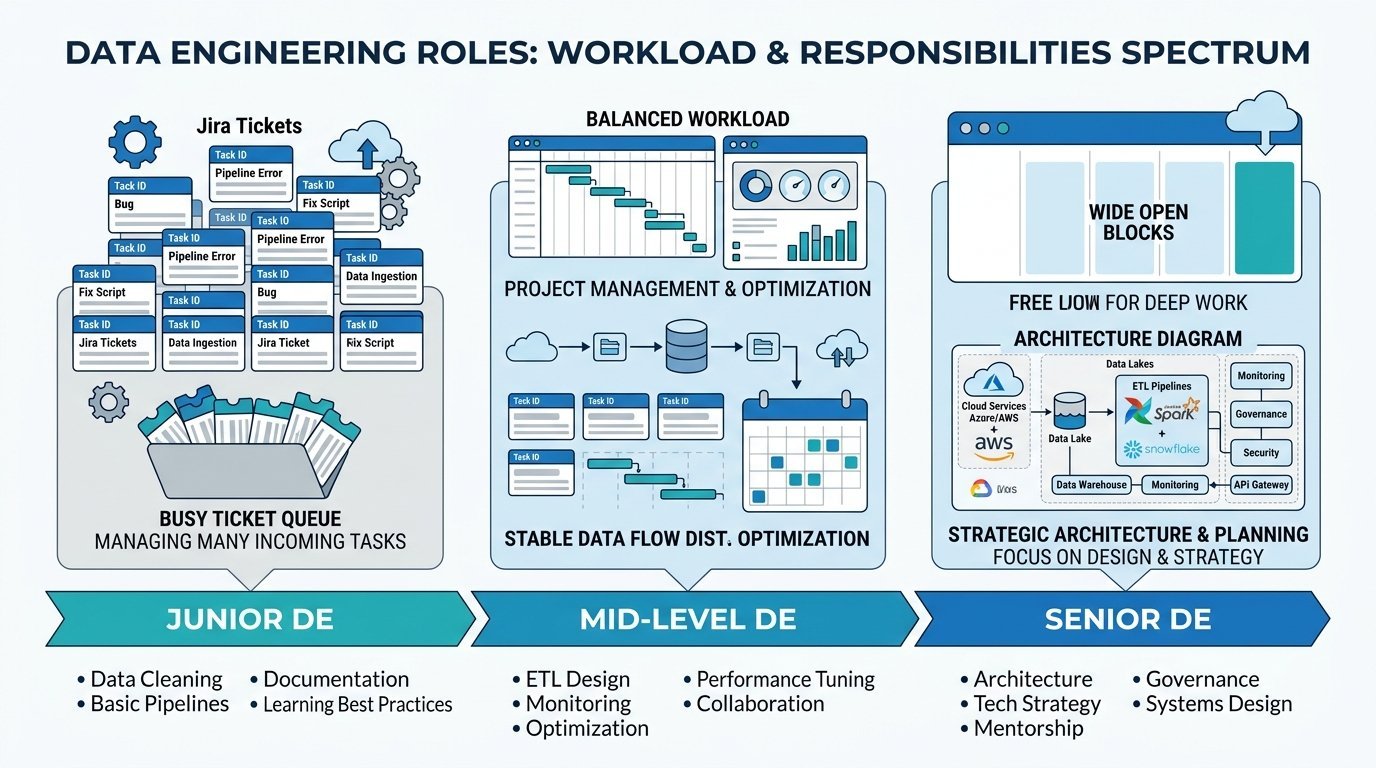
Not all data engineering jobs are equally OE-feasible. The seniority and specialization matters enormously, and the difference between a viable role and a punishing one is often invisible until you’re three weeks in. Here’s the honest spectrum.
Junior and Entry-Level (Risky)
Avoid OE at this level if you can. Junior DEs are under constant onboarding scrutiny: pair programming sessions, ramp-up reviews, weekly 1:1s with managers checking your progress. Ticket load is high and visibility is high. You’re expected to be in Slack actively, to ask questions, to be present. Managers are still calibrating whether to keep you around, so any pattern of “missing from chat” or “slow ticket throughput” stands out. Junior OE is feasible but the time savings are minimal because you’re learning the codebase, and the detection risk is elevated because your work is being watched.
Mid-Level (Viable)
This is the entry point most successful OE DEs use. By mid-level (2-5 years), you’ve established patterns, your manager trusts your ticket estimates, and the onboarding scrutiny is gone. You can absorb 5-7 tickets per sprint at a comfortable pace, and the work is repeatable enough that batching multiple tickets into a single coding session is realistic. The trade-off: ticket load is still meaningful, and you’re not yet senior enough to push back on busy-work assignments. Workable, but you’ll feel the load.
Senior, Staff, and Principal (Ideal)
This is where OE shines. Senior DEs work on architecture, technical specs, infrastructure migrations, and PR reviews. Daily output is measured in decisions and design docs, not lines of code. Meeting density drops further. You’re expected to be “available for questions” rather than “actively coding all day.” Staff and Principal DEs often have entire weeks where their visible output is a 6-page design doc and 12 PR review comments. That’s perfectly compatible with a second full-time job because both jobs are paying for senior judgment, not senior throughput.
| Role Level | OE Feasibility | Why |
|---|---|---|
| Junior DE | Low-Medium | High output expectations, visibility, onboarding scrutiny |
| Mid-level DE | Medium-High | Established, some autonomy, manageable ticket load |
| Senior DE | High | Architecture work, async, low meeting density |
| Staff/Principal DE | Very High | Strategic, largely async, minimal daily deliverables |
The practical implication: if you’re under 2 years of experience and considering OE, your first move should be to grind to mid-level at one job first, then start stacking. Trying to OE as a junior is mostly a path to burnout and accidental detection. The same logic applies to overemployed software engineers in adjacent roles: seniority is the multiplier that makes OE comfortable rather than survival mode.
Detection Risks Specific to Data Engineers
Generic OE detection advice (don’t use the same laptop, don’t share calendars, watch your tax withholding) applies to data engineers, but DEs have a handful of role-specific traps that catch even careful operators. Address all five from day one.
GitHub Commit Email Conflicts
Your local Git config commits with whatever email you’ve set globally. If you’ve ever pushed code to J1’s repo with your J2 email visible in the commit metadata, you’re done. Set per-repository Git config: git config user.email "you@j1.com" inside J1’s repo, and git config user.email "you@j2.com" inside J2’s repo. Better, use a shell function that switches based on directory. Audit your commit history weekly to confirm no leaks.
Cloud Platform Vendor Contacts
Account reps from AWS, Databricks, Snowflake, and Confluent talk to each other internally, and worse, they’re often the same person across multiple of your employer’s accounts. If your AWS solutions architect at J1 also covers J2’s account, and they recognize your email or face from a webinar, your cover collapses. Mitigation: never join cloud vendor calls with cameras on if avoidable, never use your personal email on vendor portals, and request a different rep if you recognize the name.
Data Catalog Metadata
Collibra, Alation, Atlan, and DataHub track who owns which dataset by email and SSO identity. If you appear as the “data steward” or “table owner” on two employers’ catalogs with similar metadata patterns or commit cadences visible to integration partners, that’s a forensic trail. Avoid taking ownership of high-visibility datasets, and never tie your personal email to any catalog.
Timezone Slip and Pipeline Scheduling
You scheduled a dbt run at 9am ET for J1 and the migration cutover for J2 at the same time. Both alert, both need attention, and you can only respond to one. Solution: maintain a single master calendar across both jobs (in a private Notion page, not in either employer’s calendar tool) and stagger all scheduled jobs by at least 90 minutes. Treat your J1 and J2 pipeline cron schedules as one combined system you’re managing.
IP Address Overlap
Cloud console access (AWS, GCP, Azure) logs the IP address you sign in from. If both employers’ security teams ever cross-reference IP logs, identical IPs across both accounts is a smoking gun. Mitigation: route J2’s traffic through a residential proxy or a separate VPN, especially when accessing cloud consoles. This same risk pattern affects overemployed cloud engineers at higher intensity, but DEs touch enough cloud consoles to need the same hygiene.
What Data Engineering Roles to Target for OE
The data engineering umbrella covers about a dozen subroles, and they aren’t equally OE-friendly. Target the async, infrastructure-flavored work. Avoid the alert-heavy, governance-heavy work.
Target These
Pipeline and ETL engineering. The classic ETL/ELT builder role. You write Airflow DAGs, ingest from APIs, transform to dimensional models, and load to a warehouse. Mostly async, ticket-driven, low meeting density. Highest OE feasibility within the DE space.
Analytics engineering / dbt engineer. The dbt-centric role focuses on modeling, documentation, and testing. Stakeholder interaction is async (data analysts file requests in Jira). Work is naturally batched: you build a layer of models over a sprint and document them. Very OE-friendly.
Data platform / infrastructure engineering. You maintain the warehouse, the orchestrator, the data quality tooling, and the dev environment for other engineers. The work is project-shaped (one big migration, one big upgrade) rather than ticket-shaped, which gives you huge schedule flexibility. Excellent for staff-level OE. Many DevOps engineers doing OE use the same playbook in adjacent platform roles.
Solutions architect / data architect. Mostly design docs, technical reviews, and roadmap discussions. Output is measured in artifacts (architecture diagrams, ADRs) and decisions, not code throughput. Highest TC tier and most async, with the caveat that you’ll have more “leadership presence” expectations.
Avoid These
Real-time streaming engineering. Kafka, Flink, and event-driven systems are alert-heavy. PagerDuty rotations interrupt your day at random. On-call weeks are unsurvivable in OE. Skip these roles even if the TC is attractive.
Data governance and compliance roles. Meeting-heavy. You’ll spend half your time in working groups, policy reviews, and stakeholder alignment sessions. The async leverage that makes DE great for OE disappears in governance work.
What Overemployed Data Engineers Actually Earn
The whole point is the money. Here’s what real OE DEs are pulling in 2026, based on industry comp benchmarks and the average data engineer salary in 2026, which sits around $135K base for mid-level and $180K+ for senior in major US metros.
| Scenario | J1 Comp | J2 Comp | Total | Notes |
|---|---|---|---|---|
| Mid-level OE | $130K | $130K | $260K | Achievable, manageable |
| Senior OE | $180K | $170K | $350K | Common OE sweet spot |
| Staff OE | $220K | $200K | $420K | Exists but harder to sustain |
Add equity if either job offers RSUs, and your total comp can push $500K+ in the senior and staff brackets. The realistic OE sweet spot is two senior DE roles at $170-200K each, netting $340-400K total compensation for what amounts to roughly 50-55 hours of combined effort per week. That’s the math that makes early retirement feasible within 3-5 years of disciplined OE.
The mid-level scenario is the entry path. Two mid-level roles at $130K each is meaningfully easier to sustain than two senior roles because expectations are lower, but the comp ceiling is also lower. Most OE DEs treat mid-level OE as a stepping stone: stack two mid-level roles for a year, build the savings cushion, then trade up to senior at one or both employers.
Managing Two Data Engineering Jobs: The Practical Side
Strategy is easy, operations is hard. The single biggest mistake new OE DEs make is treating both jobs as a single workflow. They aren’t. They are two parallel universes with no shared infrastructure, and the moment you blur that boundary, you start leaking signals. Here’s the operational kit you need from day one.
Browser Profiles and Cloud CLI Profiles
Use separate browser profiles (Chrome or Firefox profiles, or separate browsers entirely) per employer. Cookies, sessions, autofill, bookmarks, and saved passwords stay isolated. For AWS, use named profiles in ~/.aws/credentials: [j1] and [j2], and explicitly set AWS_PROFILE when running CLI commands. Same pattern for gcloud config configurations and az account. Never share a default profile across employers, ever.
GitHub and GitLab Segregation
Use SSH keys per employer, not email addresses. Generate ~/.ssh/id_ed25519_j1 and ~/.ssh/id_ed25519_j2, add them to each employer’s GitHub account, and use SSH host aliases in ~/.ssh/config to route per-host. Set per-repo user.email and user.name via local Git config, not global config. Audit the first 10 commits to confirm no leak. This pattern is the same one that overemployed data analyst guide readers will recognize, because the Git hygiene problem is universal in analytics-flavored roles.
Pipeline Scheduling Awareness
Treat your J1 and J2 scheduled jobs as a single combined system. Stagger them. If J1’s nightly batch alerts at 6am, schedule J2’s at 9am so failures don’t pile up. Block your morning calendar at one employer specifically to be the “handle failures” window for the other. Maintain a shared (private) list of cron schedules across both jobs so you can spot conflicts before they happen.
Calendar Blocking
Block your J1 calendar for “focus time” during J2’s standup hour, and vice versa. Block lunch windows when both employers might want a meeting. Decline optional meetings aggressively, and never say yes to a recurring meeting at either job without checking whether the slot is already committed to the other. The goal is to have at most one synchronous obligation per hour, and protect at least three deep-work hours per day for each employer.
Single Master Task Log
Keep one private master log of every task across both jobs. A Notion page works, a local markdown file works better because it never touches an employer’s infrastructure. Each entry: which job, which ticket, status, blockers. This is your air traffic control. When J1 asks “what’s the status on X” you check the log and know exactly when you last touched it. Without this, you’ll forget what you committed to, miss deadlines, and accidentally surface signs of overload.
FAQ
Can a data engineer really work two full-time remote jobs at the same time?
Yes, and many do. Data engineering is structurally one of the best OE-friendly roles in tech because the work is async, pipeline-driven, and rarely customer-facing. The realistic time investment for two senior DE roles is 50-55 hours per week combined, not 80, because the work product is decisions and code rather than constant presence. The main caveats: avoid junior roles where visibility is high, avoid streaming/governance roles where meetings dominate, and address Git and cloud detection risks from day one.
How much can an overemployed data engineer realistically make?
Mid-level OE DEs typically earn $250-280K combined. Senior OE DEs hit $320-400K. Staff and principal OE DEs can clear $450-500K when equity is included. The sweet spot for sustainability and effort is two senior roles at $170-200K each, totaling $340-400K. Going higher (staff/principal at both jobs) is achievable but the senior judgment expectations at both employers start to compete for the same hours, and you’ll burn out faster.
What are the biggest red flags that could expose an overemployed data engineer?
GitHub commit emails leaking across repos is the most common technical leak. Cloud vendor reps recognizing you across both employers’ accounts is the second. Other red flags include identical IP addresses on both cloud consoles, taking ownership of high-visibility datasets in data catalogs that span integration partners, scheduling conflicts visible in your responsiveness pattern, and accidentally referencing one employer’s internal tools in the other employer’s Slack. The fact that burnout among data engineers is well-documented also creates a secondary risk: if you let exhaustion show, managers start asking questions that probe at your engagement level.
Is data engineering remote-friendly enough for OE?
Yes. Roughly 90% of senior data engineering roles in the US are fully remote or hybrid with minimal office expectations as of 2026. Even at FAANG and traditional enterprises that have pushed return-to-office, data and platform roles are usually exempted because the work doesn’t benefit from co-location. Remote-first DE roles at startups, fintech, and consumer SaaS are abundant. The OE market for DEs is structurally healthier than for roles like product management or design where in-office expectations have crept back.
How do data engineers handle overlapping standups and sprint ceremonies?
Three tactics. First, negotiate your standup time at one job to a slot that doesn’t conflict (most teams are flexible if you ask). Second, attend both on different days if standups are 3x/week, alternating which one you skip with a quick async Slack update. Third, become the kind of engineer whose async standup write-ups are detailed enough that no one notices you’re rarely on camera. Most senior DEs do this naturally because the work is too lumpy for daily verbal updates anyway. For sprint planning, block 60 minutes biweekly at each job and treat them as the only synchronous ceremonies you can’t dodge. See the working two remote jobs playbook for a more detailed schedule template.
What’s the difference between OE as a data engineer vs. a software engineer?
Data engineers have three structural advantages. Pipelines run autonomously, so your output keeps producing value when you’re not at the keyboard. There’s no customer contact, so no surprise client escalations. Meeting density is lower because the work is naturally ticket-driven. Software engineers have one advantage: tooling abundance and ecosystem maturity for the OE setup itself, because so many SWEs do OE that the patterns are well-documented. Both roles are viable, but DE is more comfortable. If you’re choosing between specializing into DE or SWE specifically for OE purposes, DE wins. If you want to learn more about OE generally, the how to become overemployed overview covers cross-role fundamentals.
Do data engineers need to disclose multiple jobs?
Almost never legally required, but almost always contractually prohibited. Most US employment contracts contain a “moonlighting” or “outside employment” clause requiring disclosure or approval of secondary employment. Violating it isn’t illegal in most states, but it is grounds for termination. The legal landscape is more nuanced than people assume, and the situation varies by state, contract specifics, and conflict-of-interest provisions. We suggest reading our deep-dive on whether overemployment is legal before making any moves. The short version: it’s a contractual and ethical question more than a legal one, and most OE practitioners simply don’t disclose and accept the termination risk.