

Cisive Background Check: What It Checks, How Long It Takes, and What You Need to Know (2026)
December 22, 2023 | by overemployedtoolkit.com

Cisive verifies employment by contacting each employer you listed on your application directly, confirming your job title, dates of employment, and rehire eligibility through HR departments, payroll systems, or authorized agents. The process uses a mix of automated portals, phone calls, and email outreach, with a human specialist following up when employers don’t respond on their first attempt. A standard verification takes 2 to 5 business days per employer, though it can stretch longer when former companies are slow to reply or have changed hands.
What Is Cisive?
Cisive is a background screening and risk management firm founded in 1977 that runs pre-employment checks for companies across financial services, healthcare, transportation, and technology. They handle the full screening stack: criminal records, employment verification, education verification, drug testing, credit reports, and motor vehicle records. They are accredited by the Professional Background Screening Association (PBSA), which is roughly the industry’s stamp of approval for reliability and FCRA compliance.
Their client base skews heavily toward regulated industries. If you are applying to a bank, hospital, trucking company, or large publicly traded firm, there is a reasonable chance your background check will run through Cisive. They are particularly well known in the financial sector, where many of the top global banks use them for FINRA-mandated screenings.
What Does a Cisive Background Check Include?
The exact scope of a Cisive check depends on what your prospective employer orders. A finance role at a bank looks very different from a delivery driver position. Here is what each common component covers, along with where the data comes from and roughly how long it takes.
| Check Type | What It Verifies | Data Sources | Typical Timeline |
|---|---|---|---|
| Criminal history | Felony/misdemeanor convictions, federal records, sex offender registry | County, state, and federal court databases | 1-3 business days |
| Employment verification | Job titles, start/end dates, eligibility for rehire, reason for leaving (if disclosed) | HR departments, payroll systems, supervisors, authorized agents | 2-5 business days |
| Education verification | Degrees earned, graduation dates, enrollment dates | School registrars, National Student Clearinghouse | 1-3 business days |
| Credit check | Payment history, open accounts, bankruptcies, judgments | Experian, Equifax, TransUnion | 1-2 business days |
| Motor vehicle records | License status, traffic violations, DUI/DWI history | State DMV databases | 1-2 business days |
| Professional license verification | License status, expiration, disciplinary actions | State licensing boards, regulatory agencies | 1-3 business days |
Not every Cisive check includes all of these components. The employer specifies which to run, and they pay per component. Credit checks require a permissible purpose under FCRA, so they only appear for roles with financial responsibility. Motor vehicle records show up primarily for jobs that involve driving. For most office roles, you are looking at criminal history plus employment and education verification, with everything else being optional add-ons.
How Cisive Verifies Employment, Step by Step
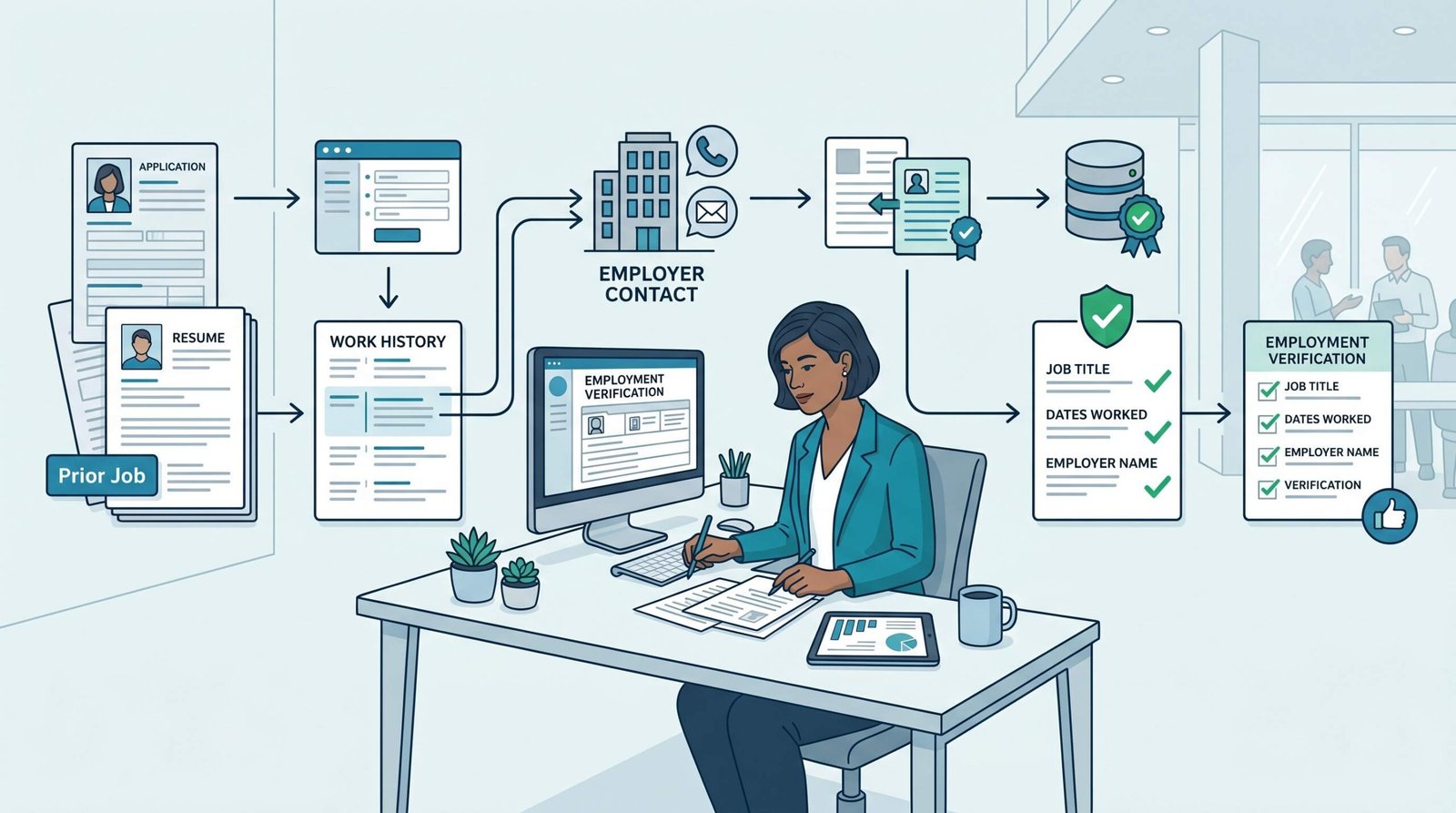
The employment verification piece is where most candidates get nervous, and it is also where the most variability lives. Here is what actually happens after you sign the consent form and Cisive begins processing your file. You can also read about the official methodology on Cisive’s employment verification process page, though it is written for employers.
- Application data extraction. Cisive pulls the employment history you listed on the application, along with the contact information you provided. This is the starting point for every verification, and it is critically important: they verify what you listed, not what they discover.
- Multi-channel outreach to each employer. Cisive contacts each former employer individually using phone, fax, email, and online HR portals. Many large companies route verification requests through services like The Work Number or Equifax Verification Services, which Cisive queries automatically. Smaller employers get a direct phone call or email to HR.
- Specialist follow-up when automated systems fail. If an employer doesn’t respond within 24 to 48 hours, a Cisive verification specialist takes over. They will call HR, ask for the payroll department, or sometimes reach out to a supervisor if HR is unreachable. This is the most common bottleneck in the process.
- Data confirmation. The verifier confirms three core data points: dates of employment, official job title, and rehire eligibility. Some employers will also volunteer the reason for leaving, but most policies prohibit that disclosure. Salary verification used to be common, but most states now restrict salary history inquiries.
- Report compilation. Verified information is added to your candidate file, which is delivered to your prospective employer once all components are complete. Any discrepancies between what you reported and what the employer confirms are flagged in the report.
The whole sequence usually takes 2 to 5 business days per employer when things go smoothly. When they don’t, the most common culprits are former employers who have been acquired, gone out of business, or who use slow manual HR processes. Verifications for jobs that ended more than 7 years ago can take longer because some companies purge records on a 7-year cycle.
What Cisive’s Employment Check Will, and Won’t, Find
This is the section most candidates care about and most articles glaze over. The distinction between what Cisive verifies and what Cisive can discover is the single most important thing to understand, especially if you are working two full-time jobs and trying to figure out what shows up where.
What gets confirmed
When Cisive successfully reaches a former employer, the report will include exact dates of employment (down to the day in most cases), your official job title as recorded in HR, and your rehire eligibility status as a yes or no flag. Sometimes the reason for separation appears if the employer’s policy allows disclosure, but more often it doesn’t. Salary may be confirmed in states where it is still legal to ask.
What Cisive does not automatically find
Cisive is a verification service, not an investigation service. They verify what you provide. They do not independently discover employers you didn’t list. This means:
- Jobs you omitted from your application will not appear in the employment verification section unless they surface through some other component of the check, like a credit report showing employer-reported income to a creditor.
- Freelance or 1099 work that was not reported through traditional HR channels typically won’t show up, since there is no HR record to verify against.
- Self-employment generally requires you to provide alternative documentation (tax returns, business registration) rather than going through standard verification.
- Internal projects, gig work, or contract assignments processed through staffing agencies may show under the agency’s name rather than the end client.
The concurrent employment question
Here is the specific scenario that brings many people to this article. If you are working multiple remote jobs simultaneously and only list one on a new application, will Cisive’s verification expose the other?
The short answer is no, not through the employment verification itself. Cisive calls each employer you listed, separately. They do not call companies you didn’t list. Even when they reach your former employers, those employers don’t typically know about your concurrent employment elsewhere unless you told them. The check confirms what you listed; it does not discover what you omitted.
There are caveats, though. If you list your current employer on the new application (which some applications require for “may we contact your current employer” purposes), Cisive will contact them. If a credit check is part of the screening, any employer-reported income on your credit file could theoretically appear, though credit reports rarely list current employers in a way that contradicts an application. And if a global database or vendor-fraud check is run, some specialized financial-industry screens cross-reference FINRA registrations, which would surface multiple registered positions.
The other thing worth flagging: managing health insurance when working two jobs creates paper trails that can sometimes surface through unrelated channels, like if a previous employer’s payroll system shows continued benefits enrollment.
The rehire eligibility trap
The single most common surprise on a Cisive employment verification isn’t a missing job or a date discrepancy. It’s a former employer marking you “not eligible for rehire.” Many employees have no idea they were tagged this way. It happens for reasons ranging from policy violations to attendance issues to nothing more than leaving without proper notice. A “not eligible for rehire” flag rarely tanks an offer by itself, but it does prompt follow-up questions from the hiring manager, and unexplained flags are worse than ones you address proactively.
If you suspect a former employer may have flagged you, it is worth either calling their HR directly to ask about your rehire status, or being ready to explain the context if it comes up during the screening process.
If you list both jobs
If you do list concurrent employment on your application, intentionally or because the application asks for all current employers, Cisive will verify both positions in parallel. The report will show two confirmed active positions with overlapping date ranges. Whether that becomes a problem depends entirely on the hiring company’s policy, not on Cisive’s process.
How to Track Your Cisive Background Check Status
Cisive operates a candidate portal where you can log in to see the progress of your background check. Most employers will email you a link to access it after they initiate the screening. The portal shows a status indicator for each component of the check, and the language is fairly standardized across most background check vendors.
Here is what each status stage actually means:
- Processing. Your check has been initiated. Cisive is gathering the information you submitted, validating identifiers, and queuing the various components.
- In Progress. Cisive is actively verifying with external sources. This is where most checks sit for the bulk of the process. Different components can be in different stages simultaneously: your criminal check may be complete while your employment verification is still pending.
- Completed. All components of the check have finished and the report has been delivered to your prospective employer.
- Pending Review. Your employer has received the completed report and their HR or compliance team is reviewing it before making a decision.
If you need an update beyond what the portal shows, you generally need to go through your employer’s HR contact rather than Cisive directly. Cisive’s customer service is set up to support employers, not candidates, so they will usually direct you back to your hiring company. If you are going through another type of background check, our guide to background check status stages covers how to interpret status codes across multiple providers.
How Long Does a Cisive Background Check Take?
For a standard package that includes criminal history plus employment and education verification, expect 3 to 5 business days when everything goes smoothly. The criminal piece tends to complete first (often within 24 to 48 hours for digital court records), followed by education, with employment verification typically being the longest single component.
What slows checks down:
- Non-responsive former employers. By far the most common delay. HR teams at smaller companies sometimes take a week or more to respond to verification requests.
- Manual HR processes. Companies that don’t use The Work Number or a similar verification service require Cisive specialists to make individual phone calls, which adds days.
- Paper court records. Some county courts still maintain paper-only criminal records. When a Cisive researcher has to physically visit a courthouse, expect an extra 3 to 7 business days for that jurisdiction.
- International verification. Education or employment outside the US can add 1 to 3 weeks. Different countries have different data protection regimes, and time zone differences alone create lag.
- Acquired or defunct employers. When a former employer has been acquired, Cisive has to identify the successor entity and route the verification there. If the company has dissolved entirely, alternative documentation may be required.
If your check has been in “In Progress” for more than 10 business days without movement, ask your prospective employer’s HR team to inquire with Cisive directly. They have a vendor relationship Cisive will respond to; you generally don’t. Note that remote jobs typically require background checks before finalizing offers, and the timeline matters if you are weighing when to give notice at a current position.
Your FCRA Rights with Cisive
Background screening is regulated under federal law, and you have specific rights that Cisive and your prospective employer must respect. Understanding these matters more if something goes wrong on your report than if everything is clean.
Under the Fair Credit Reporting Act, here is what you are entitled to:
- A copy of your report before adverse action. If a hiring decision is going to be affected by your background check, the employer must provide you with a copy of the report and a summary of your FCRA rights before taking adverse action, then wait a reasonable period (typically 5 business days) before finalizing the decision.
- The right to dispute errors. If you find inaccurate information in your Cisive report, you can dispute it directly with Cisive in writing. We suggest using certified mail with return receipt rather than the online portal, because it preserves a legal record of when the dispute was filed.
- Reinvestigation within 30 days. Once you file a dispute, Cisive must reinvestigate and respond within 30 days. If they cannot verify the disputed information, they must remove it.
- Notification of adverse action. If a background check result affects a hiring decision, the employer must notify you in writing, including Cisive’s contact information so you can request your file.
- Free annual file disclosure. You can request a free copy of your file from Cisive once per year, even if no employment action is pending.
The single most useful proactive step is to keep copies of your own employment records: offer letters, separation letters, W-2s, and final paystubs. Date errors are the most common dispute, and having your own documentation cuts the dispute resolution time significantly.
FAQ
Does Cisive contact your current employer?
Only if you list them on your application or explicitly authorize Cisive to do so. Most applications ask whether your current employer can be contacted, and you can mark “no” to delay that contact until after an offer is extended. Cisive will not surprise-call your current job.
Can Cisive find out about jobs you didn’t list?
Not through standard employment verification. Cisive verifies the employers you provide; they do not independently search for additional employers. However, other components of a comprehensive check (credit reports, FINRA registration checks for financial roles, or specialized industry databases) could theoretically surface employer information you didn’t list. For most office roles, omitted employment doesn’t appear.
What shows up on a Cisive criminal background check?
Felony and misdemeanor convictions from county, state, and federal court records, along with sex offender registry hits. Arrests without convictions are generally excluded under FCRA after 7 years for most positions. Cisive also runs national criminal database scans, but database hits are always verified against primary source court records before appearing on a final report.
How long does a Cisive background check take?
Most standard checks complete in 3 to 5 business days. Checks with international verification, manual court record retrieval, or unresponsive former employers can take 10 to 15 business days. If your check has been in progress for more than 10 business days, ask your prospective employer’s HR team to follow up with Cisive.
What can I do if Cisive has incorrect information?
File a written dispute with Cisive, ideally via certified mail. Include any documentation you have that supports the correction (offer letters, W-2s, transcripts, court records). Cisive must reinvestigate within 30 days under FCRA. If they cannot verify the disputed information from a primary source, they must remove it from your file.
Does Cisive check social media?
Cisive offers a social media screening product, but it is an optional component that employers must specifically order. When it is included, the screening focuses on publicly available content and is conducted in a way designed to filter out protected characteristics. Most standard background check packages do not include social media screening.
RELATED POSTS
View all


How to Become Overemployed: A Step-by-Step Guide for 2026
May 12, 2026 | by Ian Adair
Overemployed and Fired: What Actually Happens (And How to Protect Yourself)
December 22, 2023 | by overemployedtoolkit.com
Overemployed Cloud Engineer: The Honest Feasibility Guide for 2026
May 27, 2026 | by Ian Adair